Our corporate members are both subsidiaries of an EEA parent that is a credit institution as per Article 4(1)(1) of the CRR, or stand-alone investment firms as per Article 4(1)(2) of the CRR. Both types of entities risk becoming subject to the Maximum Ratio Rule as asset management companies licensed under either a UCITS or AIFM management company license, or licensed as investment firms under the MiFID regime to provide discretionary portfolio management services on a client-by-client basis.
EU Fund regulation
The EU fund product landscape is deep, diverse and dynamic. Since the birth of the UCITS framework in 1985, European institutions have progressively refined it into a global “gold standard”, one that successfully balances strict regulatory requirements with the flexibility required by manager to meet evolving client demands. The successful evolution of UCITS was followed by the creation of alternative investment funds (AIFs) under the 2011 AIFM Directive, adding a second important pillar to EU fund/manager regulation. Building on this second pillar are further ambitious EU fund products, such as EUSEFs, EUVECAs and ELTIFs. EFAMA has helped guide all of these key regulatory developments, informing policymakers and regulators on their main merits and drawbacks, while also keeping a close eye on their respective review initiatives.
EFAMA strongly supports a fundamental review to the ELTIF regime, in view of broadening its eligible investment universe and adapting it to better meet retail investor needs. We are also closely monitoring the review of the AIFM Directive from a product regulation standpoint, including possible spillover effects on the UCITS Directive requirements. Further work involves keeping pace with relevant ESMA initiatives, such as the work around the Common Supervisory Action on costs and fees for UCITS.
Related policy positions
Policy position

EU Fund regulation
UCITS
Management Companies
AIFMD
22 January 2016
EFAMA response to EC consultation on impacts of maximum remuneration ratio under CRD IV
Policy position
EU Fund regulation
ELTIF
Management Companies
AIFMD
Sustainable Finance
06 January 2016
EFAMA's comments on the European Commission consultation on the review of the EuVECA & EuSEF Regulations
Related news
Publication

Competitiveness
Data
EU Fund regulation
Exchange-traded Funds
Money Market Funds
UCITS
Management Companies
AIFMD
Statistics
Sustainable Finance
01 July 2021
EFAMA publishes 2021 industry Fact Book - Report highlights key developments in the European fund industry in 2020
EFAMA has released its 2021 industry Fact Book.
The 2021 Fact Book provides an in-depth analysis of trends in the European fund industry, an extensive overview of the regulatory developments across 29 European countries and a wealth of data.
Policy Position

EU Fund regulation
Money Market Funds
01 July 2021
EFAMA: No need for fundamental reform of EU Money Market Funds Regulation
The European Fund and Asset Management Association (EFAMA) has today published its response to the ESMA consultation on the legislative review of the EU Money Market Fund Regulation (MMFR).
Publication

Capital Markets Union
Competitiveness
EU Fund regulation
23 June 2021
3 questions to Miranda Seath on the European fund classification
Q #1 What is the European Fund Classification (EFC) and why is it different from other classifications?
The mission at the heart of our work on the European Fund Classification scheme is to help investors, and the wider European funds industry, to find and compare similar fund peer groups in a meaningful way. This mission is particularly relevant in an era of rising cross-border fund sales because the EFC enables investors and their advisers to compare funds across different European jurisdictions consistently.
Related publications
Infographic
EU Fund regulation
21 January 2025
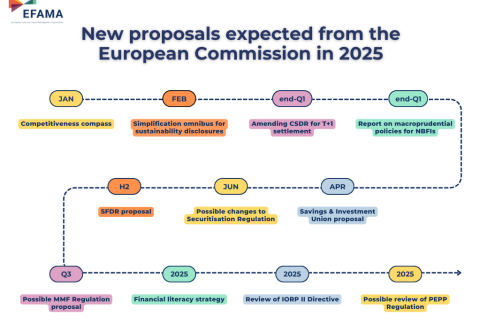
Infographic | New proposals expected from the European Commission in 2025
The new European Commission is under pressure to act quickly and decisively and are moving full steam ahead with their policy priorities in 2025.
We can expect numerous new regulatory proposals in areas of importance for asset managers, including simplification, boosting competitiveness, financial stability and a new Savings & Investment Union proposal.
The focus on competitiveness and regulatory simplicity is definitely a step in the right direction after many years of ballooning regulatory complexity.
Publication
EU Fund regulation
UCITS
04 March 2022
The costs of UCITS and US mutual funds | Market Insights | Issue #8
It is often argued that European citizens are not able to fully benefit from the single market for investment funds, on the basis that the cost of UCITS is higher than the cost of mutual funds in the United States (US). In this Market Insights, we analyse this question by carrying out a detailed comparison of the cost of UCITS and US mutual funds, taking into account the various ways of calculating costs as well as the differences between Europe and the US in the way investment funds are distributed.
Publication

EU Fund regulation
UCITS
Statistics
16 September 2021
Fund managers retain only 41% of the total cost paid by retail investors | Market Insights | Issue #6
EFAMA has released its latest Market Insights report titled “Perspective on the costs of UCITS”. The full report breaks down the costs of UCITS, focusing on the fees charged for the different services provided along the investment fund value chain and distinguishing between the product cost for which fund managers are directly responsible, and the


Contact