







EFAMA has today published its European Quarterly Statistical Release for Q4 2022, together with an overview of the full year 2022.


EFAMA has today published its response to the ESMA consultation on guidelines on funds’ names using ESG or sustainability-related terms. EFAMA members have concerns around the proposed numerical threshold approach as it may not address the underlying greenwashing issues our industry is facing due to the current lack of clarity on many key sustainable finance concepts.
EFAMA welcomes ESMA's consultation paper on guidelines on funds’ names using ESG or sustainability-related terms. We support the overarching objective to promote transparency and tackle the risk of greenwashing by ensuring that investors are protected against unsubstantiated or exaggerated sustainability claims.
EFAMA has today published its latest monthly Investment Fund Industry Fact Sheet, which provides net sales data on UCITS and AIFs for December 2022 at European level and by country of fund domiciliation. A first overview and analysis of the net sales data of UCITS and AIFs over the full year 2022 is also included.
EFAMA welcomes the recent proposal by European exchanges to build a consolidated tape. This affirms the buy-side’s long standing view that a European consolidated tape is key to completing the objectives of the Capital Markets Union and ensuring that European capital markets remain globally competitive. We have identified important use-cases for institutional and retail investors alike, not least in the ability to receive best execution on trades.
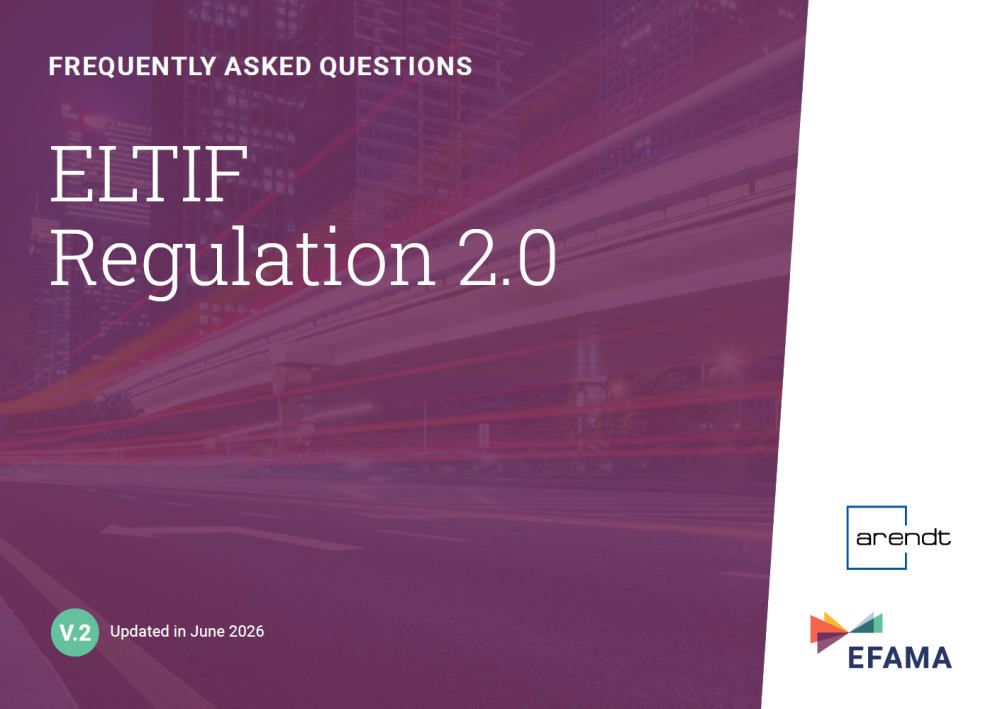
Today, the European Parliament voted in favor of amending the European Long-Term Investment Funds (ELTIF) Regulation, following the European Commission’s proposal in November 2021. The revamped regime now has the potential to become an attractive “go-to” fund structure for long-term investments, with particularly beneficial improvements for retail investors.

In the 9th issue of our “3 Questions 2” (3Q2) series, we spoke with Stuart Corrigall, Chair of the EFAMA Fund Regulation Standing Committee and Managing Director at BlackRock, on ELTIF 2.0.
He answers the following questions:
1: What is an ELTIF, and why did the current ELTIF regime need to be revised?
2: What are the major changes the review process introduced?
3: In light of those changes, is ELTIF 2.0 going to be successful?
- Asset managers represent an important group of benchmarks’ users. In this context, EURIBOR rate is used by investment funds across all kinds of asset classes and financial instruments, as well as a benchmark for measuring fund performance, driving fee calculations and determining asset allocation.
- The identification of fallback rates for the contract with reference to EURIBOR are essential for asset managers and a stable and permanent approach would make the fallback clauses more robust and ensure further transparency.
EFAMA welcomes this ESMA initiative and we agree with the conclusions in the ESMA Report that there is an overall need to strengthen the laws applicable to data in connection with the MiFIDII/MiFIR Review, aside the implementation of a Consolidated Tape . We consider that the draft Guidelines will further strengthen the MiFID level 1 and level 2 measures and will foster the establishment of a cost-based approach for market data procurement. Therefore, we would be in favour of turning the proposed guidelines into binding regulation.
The AIFMD is one of the pillars of EU regulation for asset managers and investment funds, which have a crucial role to play in the development of the Capital Markets Union (CMU) and the post Covid-19 economic recovery in the EU.
We fully support the ambitions of the new CMU Action Plan. Properly executed, it has the potential to boost the fortunes of Europe’s pensioners and savers by creating opportunities for them to share in the upside of Europe’s economic recovery and to create more efficient and better integrated European capital markets, which is key to finance European innovation as well as the transition towards a more sustainable and digital economy.
The European investment management industry is helping savers achieve their financial goals and build up retirement savings. Investment management is a vital part of the European economy, providing funding for companies and infrastructure projects and contributing to economic growth and job creation across all Member States.
As the voice of European asset management industry, EFAMA strongly welcomes the development of
the EU Taxonomy and its technical screening criteria. We see the Taxonomy as a critical tool to
unleashing the potential of sustainable finance in Europe by assisting issuers, project promoters,
companies, investors, and other financial market participants in identifying truly sustainable economic
activities. We wish to put forward recommendations that aim to improve the usability and integrity of this
framework.

Discover the 6 reasons why your organisation should become a member of EFAMA.
Our members enjoy significant benefits including the opportunity to shape the industry positions, get first-hand access to regulatory and political intelligence, engage with industry peers and policymakers, and take part in EFAMA events.
Our three membership categories cater to the wide range of organisations that make up and support the investment management industry in Europe.