This article was published in Börsen-Zeitung on 15 September 2026.
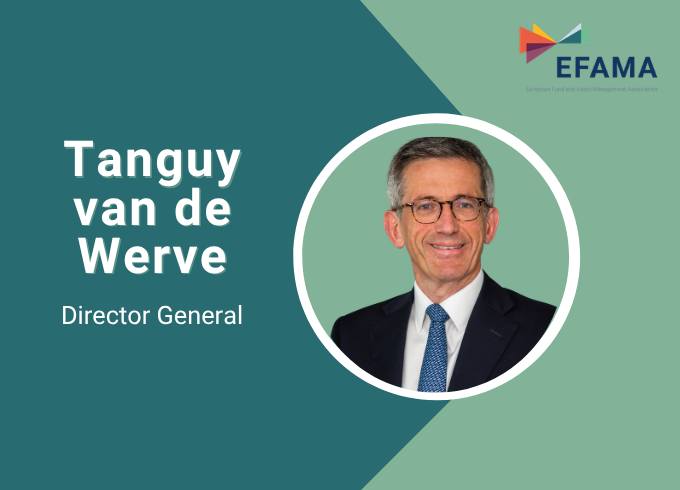
Tanguy van de Werve, Director General at the European Fund and Asset Management Association, discusses new legislation working its way through Brussels – and why he views pension reform as the real key to providing the capital needed for economic growth.
BZ: Mr van de Werve, the asset management industry is currently giving its input on two major packages working their way though the legislative process, the Market Integration and Supervision Package and the Retail Investment Strategy. The RIS is further along the legislative process than the MISP. So called Level 1 legislation has been passed, and on 24 August the EU Commission send their requests for advice on the detailed rules – Level 2 – over to ESMA. Lets start with the RIS. How does Efama view it?
The RIS should have been used to simplify the existing retail customer journey. Unfortunately, the opposite happened: it adds complexity, directly contradicting the EU Commission's competitiveness and simplification agenda. So it is a missed opportunity.
BZ: At one point there was talk in Brussels about taking the RIS off the table – a move which presumably Efama would have supported.
Only the EU Commission can withdraw legislative proposals, but it decided not to. Member States could have voted down the text but did not, much to our regret. Now that it is moving ahead, the Level 2 measures will be key, including those on value-for-money benchmarking.
BZ: Yes. One of the most controversial, and complicated, proposals, is that asset managers should demonstrate that they have been giving Value for Money, with comparisons to a peer group. The text sets out nine specific criteria, including risk profile, recommended holding period, investment strategy, distribution strategy, and whether the management is active or passive.
The nine criteria indicate the types of criteria that need to be taken into account. They should not be applied cumulatively. If you applied all nine criteria simultaneously, it would be so stringent and restrictive that defining a peer group would be very difficult for many funds.
BZ: The EU has a stated goal of greater competitiveness to promote economic growth, and also the simplification of regulation. How much will the MISP contribute to these goals do you think?
We welcome many elements of the MISP, but I don’t think the MISP will be the game changer some people claim it will be. The pension reforms being encouraged by the European Commission are likely to be far more impactful, if implemented by Member States.
BZ: So pension reform is where the focus should be as the EU looks at stimulating future economic growth?
There is no silver bullet, but I think that most people agree that the key is to grow pension assets across the EU. In particular, we need to develop occupational funded pension schemes. If you develop the second pillar, much more institutional money will be available to invest in capital markets. Some of it will, of course, be invested in the US, but some will be invested in our own EU companies.
That is where the weight of money will be…
We can talk about the RIS, Value for Money, and products such as the PEPP, but the big money sits with institutional investors, including pension funds and insurance companies. And those institutional investors can invest in private equity, private debt, infrastructure, and so on. From that perspective, auto-enrolment in occupational pension schemes is very important and a game changer. It is encouraging to see that Ireland introduced such an auto-enrolment mechanism on 1 January this year.
BZ: But these are national initiatives…
The EU Commission only recommended auto-enrolment, and it has no power to require Member States to introduce it. But things are moving in the right direction. Another very welcome recommendation gaining traction with Member States is Savings and Investment Accounts. The Commission has looked closely at SIAs in the UK, in Sweden and other countries and has identified best practices for Member States to follow.
BZ: How can the EU Commission accelerate the pace of reform?
The European Semester Spring Package, published by the Commission each May, assesses Member States' performance on macroeconomics, public finance, etc., and issues Country-Specific Recommendations (CSRs). The Commission can point out that it recommended auto-enrolment or SIAs, but a particular Member State has not done it. So some pressure can be exerted.
Therefore national initiatives, but encouraged at the EU level?
Yes. The good thing about the Savings and Investment Union launched in 2025, compared to the Capital Markets Union from 2015, is that whereas CMU was very much a top-down exercise, there is now recognition that we also need bottom-up approaches. Sweden is subject to the same rules as the other 26 Member States, yet it has far more vibrant capital markets. That is largely because Sweden reformed its pension system many decades ago. That illustrates that EU regulation alone is not sufficient. You also need effective bottom-up approaches.
Lets turn to the Market Integration and Supervision Package. The MISP is a huge document, and has two rapporteurs working on the sections relevant to asset management, Markus Ferber (EPP, Germany) and Eero Heinäluoma (S&D, Finland). Mr Heinäluoma has proposed that large cross border asset managers be directly supervised by ESMA. In fact in a number of areas Parliament goes substantially beyond the Commission proposals.
We welcome much of what is in the MISP, especially as regards harmonization of marketing documents, the consolidated tape, DLT, etc. On supervision, it is true that the Commission did not go as far as proposing direct supervision by ESMA of large asset managers. And rightly so. The Rapporteur’s far-reaching amendment came as a big surprise to us and illustrates some of the difficulties in how the EU legislative process currently works.
BZ: How?
The EU Commission is the one that makes proposals for new Regulations and Directives, and these proposals are then sent over to the Council and the European Parliament. The fact that Member States and MEPs can table significant amendments to the Commission’s proposal without any impact assessment is concerning.
BZ: There are often a large number of amendments for any particular piece of legislation. There might be hundreds of proposed amendments put forward by MEP's. Surely they can’t all do an impact assessment?
An impact assessment takes time, requires expertise, and is costly. However, this makes sense for very significant, high-impact amendments. In the case of direct supervision for asset managers, the EU Commission looked into it and concluded that it was not needed. Anyone proposing the contrary should carry out an impact assessment.
The Commission has however proposed that ESMA conduct an annual review of very large asset managers?
They looked at a number of approaches, such as a college of supervisors. Having consulted stakeholders, they came to the conclusion that direct supervision was not needed, but have proposed annual ESMA reviews. This came as a disappointment as we were hoping that the Commission would recognise that what we actually need is just more supervisory convergence.
So even annual reviews are a step too far for Efama?
It is unclear what the Commission is trying to achieve here by asking ESMA to review how the National Competent Authorities (NCAs) supervise large asset managers. It creates duplication, and ESMA using an annual review to second-guess decisions that have been made by the NCA creates uncertainty. A good regulatory proposal should be clear about what it is trying to achieve. Also, there has been no systemic supervisory failure in the asset management sector. Don't fix what is not broken.
BZ: However, in general there does seem to be more political support these days for the asset management industry, with the acceptance that efficiently channeling capital is a priority for economic growth in the EU.
There is indeed more support for our industry. But discussions such as annual reviews or direct supervision can easily become a distraction. Our focus should be on increasing retail participation in the capital markets and further developing the second and third pension pillars – occupational and private pensions.
BZ: In spite of the challenges posed by the large volume of legislation that needs to be worked on, the EU asset management industry has been doing well. There has been strong growth to hit a current Assets Under Management figure of around EUR 34 trillion.
This AuM figure reflects the market appreciation of portfolio assets such as equities and, more importantly, ever-increasing inflows of new money. From that perspective, our industry has certainly been very successful. However, there is still a lot of room to grow. Studies show that many households are not invested in capital markets at all, and much household wealth sits idle in deposit accounts. That’s why promoting investor education and simplifying the customer journey is so important.
The interview was conducted by Michael Marray.