


Net assets of UCITS and AIFs doubled over the last ten years, reaching EUR 20.7 trillion in 2023






Net assets of UCITS and AIFs doubled over the last ten years, reaching EUR 20.7 trillion in 2023

EFAMA's Annual Review highlights our key achievements over the past 12 months and provides a useful overview of the main topics we cover.
The Review is structured around the work of our Standing Committees and Taskforces. These bodies are the lifeblood of our Association as they develop sound, unified and evidence-based common positions around relevant EU/global initiatives and campaigns.

Improved Retail Investment Strategy approved but more work still to be done
Today, EU member states confirmed their position on the Retail Investment Strategy, following months of intensive negotiations under the Belgian Council Presidency. We welcome the decision to move away from banning commissions on execution-only transactions, which ensures that retail investors will still have access to direct distribution channels such as fund platforms.

European fund trends in Q1 2024 - EFAMA has today published its European Quarterly Statistical Release for Q1 of 2024.
Thomas Tilley, Senior Economist at EFAMA, commented: “Investors flocked into bond funds in anticipation of interest rate cuts. Net sales of bond funds (UCITS and AIFs) reached EUR 95 billion for the quarter, marking the highest volume of inflows since Q2 2017.”

EFAMA has published the latest Monthly Statistical Release for March 2024.

At the Roundtable on the distribution of retail investment products on 18 July 2023, the European Commissioner for Financial Stability, Financial Services and Capital Markets Union, Mairead McGuinness, invited the European Banking Federation (EBF), the European Fund and Asset Management Association (EFAMA) and Insurance Europe to advance an industry-driven process to explore common solutions aimed at increasing retail participation in EU capital markets.
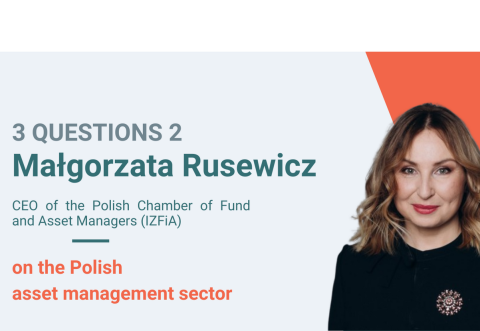
We were pleased to welcome the Polish Chamber of Fund and Asset Managers as an EFAMA member earlier this year. In the 11th issue of our “3 Questions 2” (3Q2) series, we spoke with Malgorzata Rusewicz, CEO of the Polish association, on the Polish asset management sector.
She answered the following questions:
1: What is the structure of the asset management industry in Poland?




Supervisory convergence is a core element of the Single Market and integral to removing barriers to cross-border provision of financial services. It is not enough to have a common rule book, but also the reading of those rules by supervisors and supervisory practices should converge to ensure the Single Market is not hampered by diverging interpretations and gold-plating of EU rules.

• EFAMA reiterates the European asset management industry’s strong support for the CMU project in all its dimensions. We welcome the range of initiatives, from the overarching aim of rebuilding confidence in financial markets by putting investors’ interests at the heart of the project, to the promotion of market-based financing of the economy, the development of a PEPP or the development of a comprehensive strategy on sustainable finance.

EFAMA is grateful for the opportunity to comment on the new OECD Public Discussion Draft on BEPS Action 6 and the treaty entitlement of non-CIV funds Discussion Draft on non-CIV examples. In addition EFAMA would like to make positive use of this opportunity and comment as well on the general situation of CIVs as well as of Non-CIVs against the background of the BEPS Action 6 implementation.

EFAMA welcomes the opportunity to respond to the EBA on its proposal for a new prudential regime for investment firms. As the EBA is aware, the activity of portfolio management on behalf of thirdparty clients broadly falls under three separate EU legal regimes:
i. Individual discretionary portfolio management performed by investment firms on a client-byclient basis, authorised under and complying with the Markets in Financial Instruments Directive, as per Annex I Section A, point 4 (as recently amended by MiFID II);
EFAMA welcomes ESMA’s Consultation Paper on product governance requirements and specifically on the target market assessment and supports that the details of these requirements are laid out in the form of guidelines rather than Q&A. We agree with ESMA that drafting target market guidelines is an important aspect “for ensuring the common, uniform and consistent application” of the MIFID II product governance requirements, in particular since these rules have the potential to significantly alter the European distribution landscape.
Discover the 6 reasons why your organisation should become a member of EFAMA.
Our members enjoy significant benefits including the opportunity to shape the industry positions, get first-hand access to regulatory and political intelligence, engage with industry peers and policymakers, and take part in EFAMA events.
Our three membership categories cater to the wide range of organisations that make up and support the investment management industry in Europe.