


A significant step forward taken to remove tax barriers to the CMU







We were pleased to welcome the Polish Chamber of Fund and Asset Managers as an EFAMA member earlier this year. In the 11th issue of our “3 Questions 2” (3Q2) series, we spoke with Małgorzata Rusewicz, CEO of the Polish association, on the Polish asset management sector.
She answers the following questions:
1: What is the structure of the asset management industry in Poland?
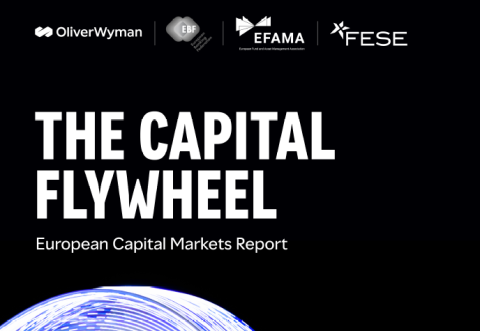
The European Banking Federation (EBF), the European Fund and Asset Management Association (EFAMA), and the Federation of European Securities Exchanges (FESE) have released a joint report on the development of European capital markets and recommendations to enhance their competitiveness.

The European Capital Markets Report is a joint initiative authored by Oliver Wyman and co-developed by EFAMA, the European Banking Federation (EBF) and the Federation of European Securities Exchanges (FESE). This report reviews progress made towards the CMU and provides recommendations on how to improve the competitiveness of European capital markets.

Today, EFAMA has published our latest Monthly Statistical Release for February 2024.

Latest EFAMA research shows banks hold a 57% market share in EU fund distribution
Today, the European Fund and Asset Management Association (EFAMA) published the latest edition of its Market Insights series, titled “Investment fund distribution channels in Europe”.

The European Parliament today formalised its position on the Retail Investment Strategy, which significantly improves on the original European Commission proposal.

Former Italian prime minister Enrico Letta has released today his report on the future of the Single Market. Together with the recent statement of the Eurogroup in inclusive format on the future of CMU, and the upcoming report of Mario Draghi, there is increasing emphasis on EU competitiveness and the need to make urgent progress towards achieving a well-functioning Capital Markets Union to finance Europe’s necessary transitions.



EFAMA fully supports the Commission’s initiatives to fight tax avoidance and aggressive tax planning. The work of the technical teams that acknowledged our industry’s special requirements and the proposal of carve-out rules to protect investment structures and end-investors are, to a certain extent, to be welcomed.

EFAMA appreciates the opportunity to share our views on the European Commission’s consultation on enhancements to the suitability and appropriateness assessments forming part of the wider, upcoming Retail Investment Strategy.

EFAMA welcomes the decision of the European Commission to adopt a targeted approach in its review of the Alternative Investment Fund Management Directive (AIFMD), along with key harmonising provisions within the Undertakings for Collective Investment in Transferrable Securities Directive (UCITSD). This focus on targeted improvements recognises the role this framework has played in encouraging the growth in the European Alternative Investment Fund (AIF) market over the past decade and its resilience even throughout recent market stresses.

EFAMA strongly supports the Commission's draft proposal amending the ELTIF Regulation where it addresses some of the major obstacles that have undermined the attractiveness of the ELTIF product since inception. The revised legal framework has the potential to transform ELTIF into a product of choice for a larger (retail) investor audience, all while serving the purposes of the Capital Markets Union (CMU). However, some important adjustments remain to be made for the ELTIF regime to reach its full potential as a competitive long-term investment option.

The European Commission’s proposal on MiFIR establishes the blueprint for a consolidated tape (CT) for Europe’s capital markets. It also significantly alters the competitive market structure brought about by MiFID II by introducing greater transparency requirements. Finally, it addresses important issues around market data costs.

EFAMA replied to IASB’s request for information on the Post-Implementation Review (PIR) of IFRS 9 – Classification and measurement. Our paper recaps EFAMA’s key concerns and recommendations to the IASB. The key concerns of the industry are the removal of recycling (in particular for institutional investors) and the classification of investment entities and investment funds as debt instruments.
Discover the 6 reasons why your organisation should become a member of EFAMA.
Our members enjoy significant benefits including the opportunity to shape the industry positions, get first-hand access to regulatory and political intelligence, engage with industry peers and policymakers, and take part in EFAMA events.
Our three membership categories cater to the wide range of organisations that make up and support the investment management industry in Europe.