


A significant step forward taken to remove tax barriers to the CMU



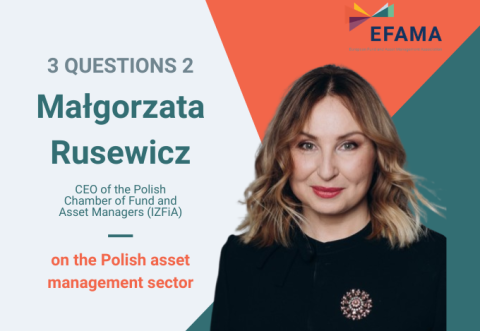
We were pleased to welcome the Polish Chamber of Fund and Asset Managers as an EFAMA member earlier this year. In the 11th issue of our “3 Questions 2” (3Q2) series, we spoke with Małgorzata Rusewicz, CEO of the Polish association, on the Polish asset management sector.
She answers the following questions:
1: What is the structure of the asset management industry in Poland?
The European Banking Federation (EBF), the European Fund and Asset Management Association (EFAMA), and the Federation of European Securities Exchanges (FESE) have released a joint report on the development of European capital markets and recommendations to enhance their competitiveness.
The European Capital Markets Report is a joint initiative authored by Oliver Wyman and co-developed by EFAMA, the European Banking Federation (EBF) and the Federation of European Securities Exchanges (FESE). This report reviews progress made towards the CMU and provides recommendations on how to improve the competitiveness of European capital markets.

Today, EFAMA has published our latest Monthly Statistical Release for February 2024.

Latest EFAMA research shows banks hold a 57% market share in EU fund distribution
Today, the European Fund and Asset Management Association (EFAMA) published the latest edition of its Market Insights series, titled “Investment fund distribution channels in Europe”.

The European Parliament today formalised its position on the Retail Investment Strategy, which significantly improves on the original European Commission proposal.

Former Italian prime minister Enrico Letta has released today his report on the future of the Single Market. Together with the recent statement of the Eurogroup in inclusive format on the future of CMU, and the upcoming report of Mario Draghi, there is increasing emphasis on EU competitiveness and the need to make urgent progress towards achieving a well-functioning Capital Markets Union to finance Europe’s necessary transitions.



EFAMA, the voice of the European investment management industry, strongly supports the initiative to establish an EU Green Bond Standard (GBS). We believe that, thanks to the recommendations made by the TEG, the GBS has a great potential to effectively play its important role in financing assets needed for the low-carbon transition.

EFAMA comments the IASB's Exposure Draft (ED/2017/7). It supports IASB's efforts to improve consistency in the layout of the primary financial statements and the relevance of financial statements.
Proposals around new defined sub-totals and line items will improve consistency and will assist in the implementation of electronic reporting format initiatives.

EFAMA appreciates the Commission's efforts in pursuing an alleviation of certain MiFID II requirements in the interest of promoting a swift recovery from the economic crisis precipitated by the Covid-19 pandemic (....).
EFAMA believes however that there are more effective ways to foster SME access to markets and urges the Commission to consider a set of further measures (...)

In light of the current COVID-19 circumstances and the already existing ambitious time table for the implementation, EFAMA calls for the EBA to carefully consider these circumstances and request the EC to postpone the date for the application of the IFD/IFR framework (26 June 2021) and the time table of the level 2 measures (such as the deadline of 26 December 2020 for providing drafted RTS and ITS).

EFAMA considers the Sustainable Finance Disclosure Regulation (SFDR) and its accompanying technical standards essential pieces in a strong and ambitious framework for sustainable investing. Its feedback aims at improving the effectiveness and feasibility of the ESAs’ proposal, as well as strengthening this regulation’s synergies with existing and upcoming rules.

A holistic approach is recommended when establishing whether the use of leverage of AIFs poses leverage-related systemic risk and materially contributes to financial instability. Any regulatory policies on leverage need to be evidence-based and developed with empirical evidence showing the extent to which the use of leverage in AIFs contributes to the build-up of systemic risk. The Covid-19 pandemic is testament that no major dysfunction was reported in terms of use of leverage by AIFs.
Discover the 6 reasons why your organisation should become a member of EFAMA.
Our members enjoy significant benefits including the opportunity to shape the industry positions, get first-hand access to regulatory and political intelligence, engage with industry peers and policymakers, and take part in EFAMA events.
Our three membership categories cater to the wide range of organisations that make up and support the investment management industry in Europe.