


A significant step forward taken to remove tax barriers to the CMU




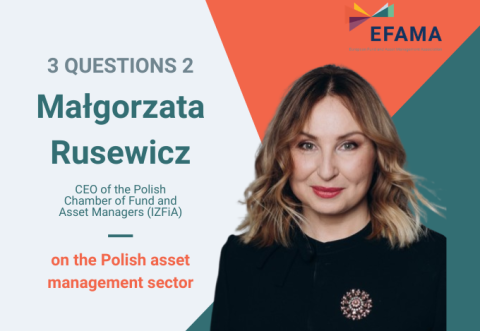
We were pleased to welcome the Polish Chamber of Fund and Asset Managers as an EFAMA member earlier this year. In the 11th issue of our “3 Questions 2” (3Q2) series, we spoke with Małgorzata Rusewicz, CEO of the Polish association, on the Polish asset management sector.
She answers the following questions:
1: What is the structure of the asset management industry in Poland?
The European Banking Federation (EBF), the European Fund and Asset Management Association (EFAMA), and the Federation of European Securities Exchanges (FESE) have released a joint report on the development of European capital markets and recommendations to enhance their competitiveness.
The European Capital Markets Report is a joint initiative authored by Oliver Wyman and co-developed by EFAMA, the European Banking Federation (EBF) and the Federation of European Securities Exchanges (FESE). This report reviews progress made towards the CMU and provides recommendations on how to improve the competitiveness of European capital markets.

Today, EFAMA has published our latest Monthly Statistical Release for February 2024.

Latest EFAMA research shows banks hold a 57% market share in EU fund distribution
Today, the European Fund and Asset Management Association (EFAMA) published the latest edition of its Market Insights series, titled “Investment fund distribution channels in Europe”.

The European Parliament today formalised its position on the Retail Investment Strategy, which significantly improves on the original European Commission proposal.

Former Italian prime minister Enrico Letta has released today his report on the future of the Single Market. Together with the recent statement of the Eurogroup in inclusive format on the future of CMU, and the upcoming report of Mario Draghi, there is increasing emphasis on EU competitiveness and the need to make urgent progress towards achieving a well-functioning Capital Markets Union to finance Europe’s necessary transitions.




EFAMA supports the European Commission’s Omnibus Simplification Package as a crucial step towards reducing bureaucracy and enhancing EU competitiveness. While simplification is necessary, given the current geopolitical developments, it must not compromise the availability and quality of essential sustainable information for investors and asset managers. We, therefore, consider legal clarity and alignment across EU regulations essential to support the transition to a sustainable economy.



EFAMA welcomes the FSB recommendation that jurisdictions develop domestic frameworks to monitor and mitigate the build-up of leverage. These analytical frameworks should take a holistic approach and be empirically driven. The main systemic risk stemming from leverage is the imbalance between liquidity demand and supply during periods of stress, not the (collective) default of non-bank financial intermediaries.

In its response to IOSCO’s consultation on the revised recommendations for liquidity risk management for collective investment schemes, EFAMA welcomes the fact that IOSCO recognises aspects essential for proper risk management (e.g., asset managers’ primary responsibility and the absence of one-size-fits-all approaches).
Discover the 6 reasons why your organisation should become a member of EFAMA.
Our members enjoy significant benefits including the opportunity to shape the industry positions, get first-hand access to regulatory and political intelligence, engage with industry peers and policymakers, and take part in EFAMA events.
Our three membership categories cater to the wide range of organisations that make up and support the investment management industry in Europe.