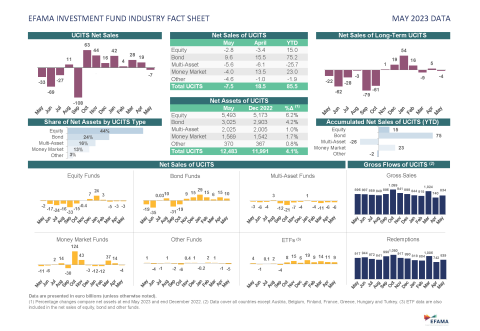









EFAMA has today published its latest monthly Investment Fund Industry Fact Sheet, which provides net sales data on UCITS and AIFs for August 2022, at European level and by country of fund domiciliation.


EFAMA has released today a new issue of its Market Insights series titled “ESG ratings of Article 8 and 9 funds: assessing the current market and policy recommendations for the future”. This research was motivated by the development of the market for ESG ratings against the backdrop of a growing demand for Article 8 and 9 funds, two ESG-related fund categories introduced by the Sustainability Financial Disclosure Regulation (SFDR).
EFAMA wholeheartedly supports ESMA’s objective of ensuring a consistent and harmonised application of the MiFID II product governance requirements. In our response to their consultation on the topic, we raised the following points:
EFAMA has today published its latest monthly Investment Fund Industry Fact Sheet, which provides net sales data on UCITS and AIFs for July 2022, at European level and by country of fund domiciliation.
EFAMA has today published its International Quarterly Statistical Release regarding the developments in the worldwide investment fund industry during the second quarter of 2022.
EFAMA welcomes the European Securities and Market Authority’s continuous commitment to creating a single market for investment funds, confirmed by the draft regulatory standards currently under consideration. These RTS/ITS would further harmonise information that asset managers should provide to their national competent authorities before marketing or managing an investment fund on a cross-border basis, thus facilitating intra-EU product distribution.
EFAMA has today published its European Quarterly Statistical Release for Q2 2022.
EFAMA welcomes the FSB recommendation that jurisdictions develop domestic frameworks to monitor and mitigate the build-up of leverage. These analytical frameworks should take a holistic approach and be empirically driven. The main systemic risk stemming from leverage is the imbalance between liquidity demand and supply during periods of stress, not the (collective) default of non-bank financial intermediaries.
In its response to IOSCO’s consultation on the revised recommendations for liquidity risk management for collective investment schemes, EFAMA welcomes the fact that IOSCO recognises aspects essential for proper risk management (e.g., asset managers’ primary responsibility and the absence of one-size-fits-all approaches).
EFAMA has submitted its response to ESMA’s consultation on the Active Account Requirements (AAR). Our industry stands ready to implement the AAR by June 2025... However, we have strong reservations about the heavy and redundant reporting requirements.

Discover the 6 reasons why your organisation should become a member of EFAMA.
Our members enjoy significant benefits including the opportunity to shape the industry positions, get first-hand access to regulatory and political intelligence, engage with industry peers and policymakers, and take part in EFAMA events.
Our three membership categories cater to the wide range of organisations that make up and support the investment management industry in Europe.