


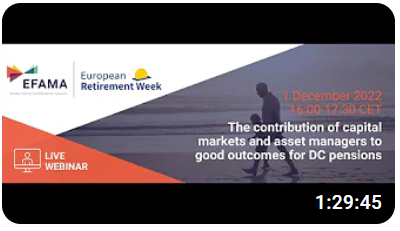
The European Retirement Week 2022 took place from 28 November to 3 December 2022.




The European Retirement Week 2022 took place from 28 November to 3 December 2022.

EFAMA has today published its European Quarterly Statistical Release for Q3 of 2022.
This Release presents for the first time data on the net sales and net assets of SFDR Article 8 and 9 UCITS.

EFAMA members are paying close attention to the ongoing discussions in the European Parliament and Council to reach a compromise on the MiFID review. Together with a broad majority of market participants, including the sell-side and alternative trading venues, we have consistently made the case for a real-time tape for equities with the inclusion of pre and post-trade data.

Following in the footsteps of the European Parliament earlier this month, the Council of the EU has now finalised the legislative process by adopting the Corporate Sustainability Reporting Directive (CSRD), a move which is very much welcomed by EFAMA. This comes days after the first set of European Sustainability Reporting Standards (ESRS), which give life to the double materiality principle established by the CSRD, were finalised by EFRAG and submitted to the European Commission for adoption.

EFAMA spoke with its own Bernard Delbecque, Senior Director of Economics & Research, for the publication of the 8th issue of the "3 Questions 2" (3Q2) series, on rethinking our pension system sustainability and adequacy.
The aim of 3Q2 is to raise awareness on specific topics of interest to our membership in a clear and concise manner.
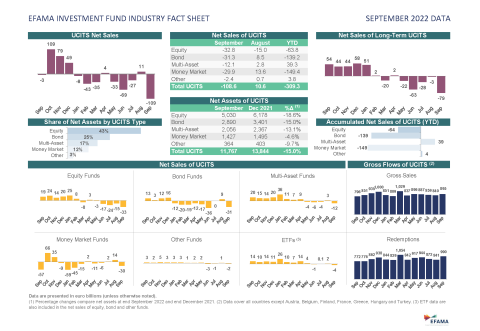
EFAMA has today published its latest monthly Investment Fund Industry Fact Sheet, which provides net sales data on UCITS and AIFs for September 2022, at European level and by country of fund domiciliation.
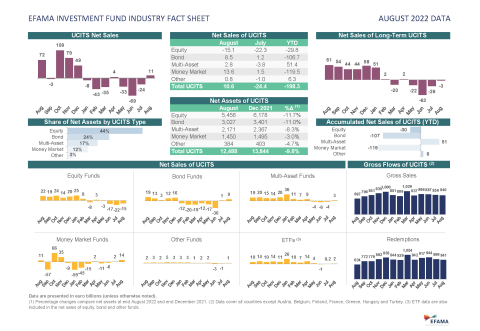
EFAMA has today published its latest monthly Investment Fund Industry Fact Sheet, which provides net sales data on UCITS and AIFs for August 2022, at European level and by country of fund domiciliation.





In response to the ESMA’s Discussion Paper on the integration of funds’ data, EFAMA concurs with ESMA’s findings that the European asset management industry is subject to multiple and uncoordinated reporting requirements at both the national and European levels.


Discover the 6 reasons why your organisation should become a member of EFAMA.
Our members enjoy significant benefits including the opportunity to shape the industry positions, get first-hand access to regulatory and political intelligence, engage with industry peers and policymakers, and take part in EFAMA events.
Our three membership categories cater to the wide range of organisations that make up and support the investment management industry in Europe.