
New EFAMA report highlights the portfolio diversification and insurance-protection benefits of catastrophe bonds as EU policymakers review UCITS eligible assets.
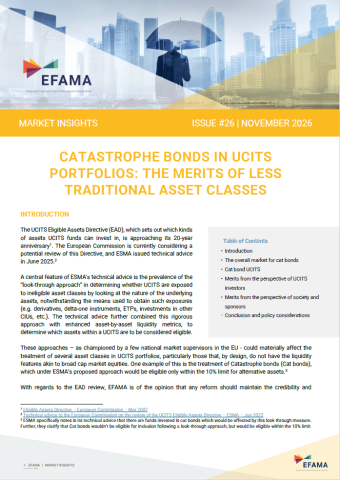
Today EFAMA published a new Market Insights report, “Catastrophe bonds in UCITS portfolios: the merits of less traditional asset classes”. It examines the role of catastrophe bonds (Cat bonds) in portfolio diversification and natural disaster risk transfer, as the European Commission considers a review of the UCITS Eligible Assets Directive (EAD).
Some key findings include:
The Cat bond market has grown steadily, with UCITS playing an important role. The market reached USD 65.6bn outstanding in 2026. Twenty-one Cat bond-focused UCITS manage around USD 21bn, almost one-third of the market.
Cat bonds can diversify portfolios. Their risk drivers differ from those of equities and corporate bonds. ESMA found correlations of just 0.19–0.29 with major asset classes they examined.
Cat bonds have an established secondary market. They can trade daily, although buy-and-hold is common. Estimated annual secondary-market turnover is 23%, versus 33% for investment-grade and 19% for high-yield European corporate bonds. Average maturities are around three years.
Cat bond UCITS are mainly used through professional and intermediated channels. According to industry estimates, direct retail investors account for only around 1% of the investor base. UCITS access can be important for investors whose mandates restrict other fund structures.
Cat bonds can help address the insurance protection gap. By transferring catastrophe risks to capital-market investors, they add insurance capacity. The European Commission has noted that only around 25% of catastrophe losses in Europe are privately insured.
With regards to potential changes in the EAD, EFAMA is of the opinion that:
Any reform should maintain the credibility and recognition of the UCITS label globally.
UCITS should retain a degree of flexibility to access – in a controlled manner – the benefits of limited exposure to assets uncorrelated to financial markets.
Investors should have access to an investment portfolio that reflects contemporary best practices in allocation and diversification terms, allowing asset managers to access the broadest possible investment universe while enabling the UCITS brand to play its part in the climate change transition and adaptation efforts.
Federico Cupelli, EFAMA’s Deputy Director of Regulatory Policy, commented: “Catastrophe bonds offer investors relevant diversification benefits and have a well-established secondary market. Rather than revisiting their eligibility, policymakers should focus on preserving the conditions that have enabled such instruments to contribute effectively to UCITS portfolio construction. The current UCITS EAD framework is effective and should remain in place.”
Dan Irwin-Brown, EFAMA’s Director of Market Insights, Data & Analytics, also commented: “Cat bonds offer valuable diversification benefits because they are exposed to insurance-related risks whose drivers differ from those influencing traditional financial assets. They are a good example of why investors should retain access to alternative asset classes within the well-regulated UCITS framework.”
- ENDS -
For further information, please contact:
Hayley McEwen
Head of Communications & Membership Development
About the Market Insights
EFAMA’s Market Insights series analyses recent industry trends and developments based on the latest available data and presents our findings in the context of current policy perspectives. We publish numerous concise reports each year covering diverse topics such as competitiveness, costs and performance, ETFs, alternative investments, retail investing, ESG fund markets, and more.