UCITS
UCITS (Undertakings for Collective Investment in Transferable Securities) refers to the EU framework for harmonising the creation, management and marketing of collective investment schemes in the EU (and EEA) Member States. It places a strong focus on investors’ protection and product regulation. Owing to this harmonised framework, once UCITS funds are registered in one Member State, they can be freely marketed across the European Union. Initially adopted in 1985, the UCITS Directive has since been modified repeatedly, to take into account developments in financial markets.
EFAMA is adamant to protect the competitiveness and international appeal of UCITS.

Use of Leverage in Investment Funds in Europe | AMIC-EFAMA Joint Paper
EFAMA response to the IOSCO Consultation on Termination of Investment Funds
EFAMA welcomes the opportunity to provide its comments on the Good Practices to be adopted by IOSCO for the Termination of Investment Funds. We agree that the decision to terminate a fund can have significant impact on investors in terms of the costs associated with such an action, or the ability for investors to redeem their holdings during the termination process. In this regard, even in the context of a fund’s voluntary termination, asset managers must abide by their fiduciary obligation to act in the best interest of their investors.
EFAMA response to the European Commission’s consultation on the barriers to cross-border distribution of funds
EFAMA welcomes the consultation that the European Commission launched on the cross-border distribution of different types of investment funds (AIFs, UCITS, EuVECA/EuSEF, and ELTIF) and the opportunity to respond as to the remaining barriers to marketing funds across the EU single market, as well as the ways to eliminate them. We, also, fully share the goal of the European Commission in seeking further ways to deepen the Single Market for investment funds.

Open-ended funds and resilient capital markets - the perspective of the European asset management industry
For the best part of this decade, macro-prudential supervisors have argued that investment funds contribute to the build-up of systemic risks. Today, EFAMA has published an ambitious report that provides a comprehensive overview of the contribution of the European investment fund sector to the diversity and resilience of capital markets.
Some key findings include:

High-level response to ESMA consultation on notifications for cross-border marketing and management of AIFs and UCITS
EFAMA welcomes the European Securities and Market Authority’s continuous commitment to creating a single market for investment funds, confirmed by the draft regulatory standards currently under consideration. These RTS/ITS would further harmonise information that asset managers should provide to their national competent authorities before marketing or managing an investment fund on a cross-border basis, thus facilitating intra-EU product distribution.

EFAMA welcomes adoption by Council of its General Approach to AIFMD & UCITS Reviews
For immediate release, Brussels - EFAMA welcomes the adoption by Council of its general approach to the AIFMD and UCITS reviews today. We commend the swift progress made by the French Presidency in this regard and its thorough approach to the review.

EFAMA Market Insights | Issue #1 | Net outflows from UCITS in March 2020 - Industry weathers Covid-19 crisis
The Covid-19 pandemic significantly impacted financial markets. Stock markets across the world suffered a steep decline driven by lower economic growth and corporate profits. As anticipated, the crisis caused substantial net outflows from UCITS in March (EUR 313 billion). However, as a percentage of net assets, these outflows were no higher than in October 2008, at the height of the global financial crisis (2.9%).
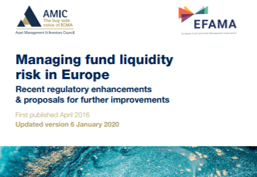
AMIC EFAMA Report - Managing fund liquidity risk in Europe - 2020
In 2019, AMIC and EFAMA decided to update their 2016 report “Managing Fund Liquidity Risk in Europe” following important policy and regulatory developments at EU and international levels. The purpose of this updated report is to outline the practical liquidity risk management processes which fund management companies put in place when setting up a fund and implement throughout the life of the fund. Also, the report describes the existing European and international regulatory frameworks in the area of fund liquidity risk management.
Managing fund liquidity risk in Europe: An AMIC-EFAMA Report