
This article was first published in the 23rd edition of the Fact Book on 24 June 2025.
Despite a complex landscape marked by sticky inflation, shifting interest rate expectations and ongoing geopolitical tensions, equity UCITS still delivered a strong average net performance of 18.1% in 2024.1 As the ECB (European Central Bank) and other major central banks indicated they would stop raising interest rates, yields began to stabilise, increasing bond prices as a result. Following a challenging 2022–2023, this brought about a notable rebound in bond UCITS, as they posted an average net performance of 6.5%.
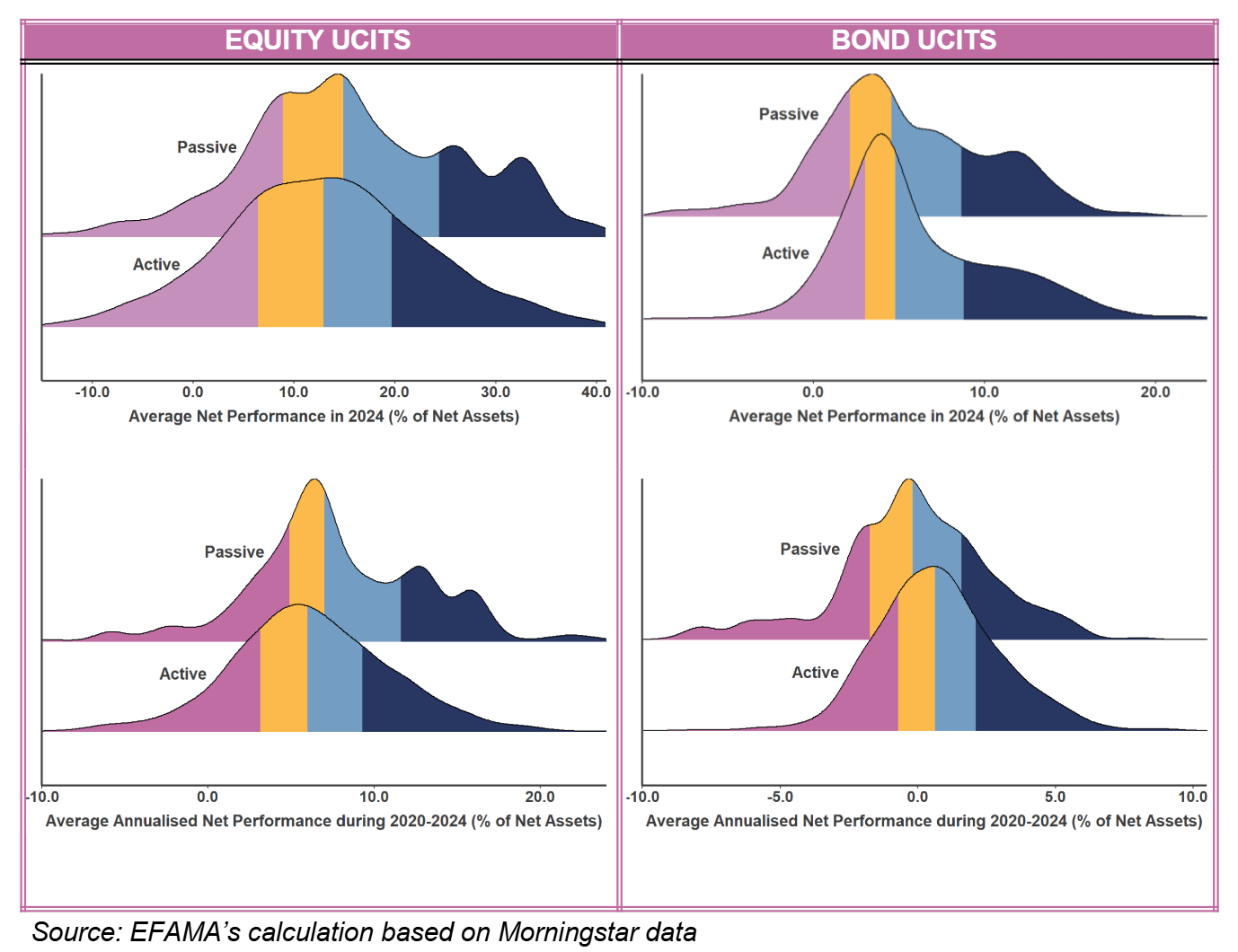
Each UCITS category encompasses a wide range of fund characteristics - investment strategy, sectoral and regional focus as well as risk profile - so averages alone cannot capture the full spectrum of investor outcomes.2 By way of illustration, we analysed the distribution of annual net performance for equity and bond UCITS, both in 2024 and between 2020–2024. The density distribution charts clearly illustrate the broad range of outcomes for both active and passive funds.
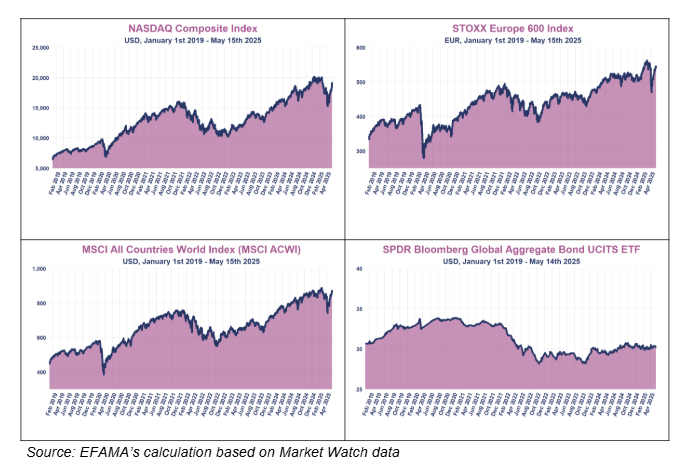
Stock market positive momentum carried on into early 2025; however, escalating geopolitical tensions and abrupt shifts in US trade policy triggered a sharp market correction in early April 2025. The NASDAQ Composite plunged nearly 12% in the first two trading sessions of 3-4 April. At the same time, the MSCI All Country World Index (ACWI) - which tracks both developed and emerging markets - declined by more than 7% and Europe's EURO STOXX 600 fell more than 8%, dragged down by fears for the outlook for export-driven industries. Even bond markets, usually considered a safe place during market turmoil, were affected. The Bloomberg Global Aggregate Bond Index3 faced downward pressure as yields surged, driven by deepening uncertainty and evolving expectations for central bank policy.
The charts below highlight the severity of the April market downturn, but also the speed of the subsequent rebound, underscoring how volatility can cut both ways. Only days later, on 8 April, the NASDAQ surged by more than 12%, its largest single-day gain in over two decades.
Another notable development has been the strong performance of European equities in early 2025. Between 1 January - 15 May 2025, these stocks outperformed both global and US markets.4 Several factors seem likely to have contributed to this outperformance, including elevated US stock valuations at the start of the year, growing investor unease over newly imposed US tariffs and renewed optimism around Europe’s commitment to boosting economic competitiveness.
These developments are a powerful reminder that volatility and market corrections are inherent in the investment journey, and that sharp declines can create compelling opportunities for long-term investors. Those who maintained a diversified portfolio and remained focused on their long-term objectives were well-positioned to benefit from the recent rebound. While the outlook for the coming months remains uncertain amid persistent global risks, the experience to date this year reinforces the importance of diversification and maintaining a long-term perspective.
Notes to Editors
Access the original article here.