This article was first published in Funds Europe on 6 March 2025.
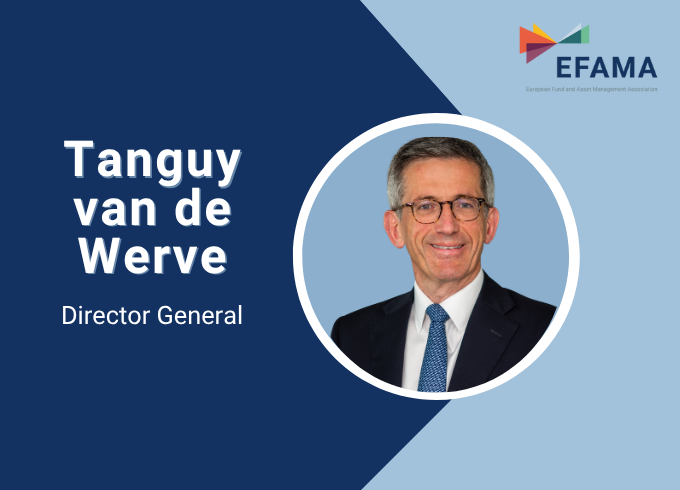
Renewed efforts must be made to encourage citizens to invest, writes Tanguy van de Werve, EFAMA director general. This includes collaboration to radically simplify the Retail Investment Strategy.
Recent figures published by several national authorities indicate a modest increase in the amount of investment products held by their residents. While this is encouraging, a closer examination of EU-wide figures reveals significant disparities among EU Member States and, most importantly, shows that within many countries, only a minor percentage of the population is invested in capital markets, especially equities. Consequently, only a small fraction of the EU population reaps the rewards of long-term investing.
This situation is concerning as most European countries face an increasing pension gap. State pensions will not be sufficient for many people to make ends meet after retirement, especially considering they may have 20 years or more to live thereafter. Renewed efforts must be made to encourage citizens to invest in capital markets and secure their financial future.
Cost is not the main barrier to retail investing
The cost of retail investment products is an important consideration given its impact on total returns. However, the primary reason most citizens do not invest is not cost-related. If cost was the main issue, it would imply that EU citizens are familiar with investment products, keen to invest, and capable of understanding disclosure documents. Unfortunately, for the majority of the population, this is not the case. If this was mainly a cost issue, then why do most people continue to keep their savings in bank deposits, which carry their own costs, including huge opportunity costs due to inflation? And why are notoriously expensive capital-guaranteed long-term investment products so successful in certain EU member states?
When people are asked why they are not invested in capital markets, they hardly ever mention costs.
Even if we assume cost is the main barrier to retail investing, which is a big assumption, does this require regulatory intervention? Costs continue to decline every year due to market competition, and low-cost products like passive ETFs are very popular with retail investors, a trend that most experts say is set to continue.
The investor journey is too complex
When people are asked why they are not invested in capital markets, they hardly ever mention costs. Instead, their reasons usually relate to risk aversion, lack of financial literacy, the mistaken belief that one needs to be wealthy to start investing, the equally erroneous belief that the welfare state will provide for them in old age, and a perception that investing is overly complex.
The issue of complexity is closely linked to risk aversion. Research shows that what is perceived as complex is often deemed risky. The question then becomes: what is complex, the product or the onboarding process and the disclosures? I would argue it is primarily the latter, particularly in the case of Ucits.
The overwhelming majority of Ucits are simple and easy-to-understand products. In addition, all are well-diversified and professionally managed, which means there is no need for the investor to master the intricacies of the underlying securities. Ucits is the most successful story in the EU financial services space. Therefore, the European Commission should refrain from launching a new simple and low-cost product that could undermine the unicity and global success of the Ucits brand.
When it comes to the onboarding process and disclosures, however, these can be off-putting for potential investors. The PRIIPs KID is not easy to understand and often not even read. The onboarding process feels like an obstacle course. And to make things worse, the recent MiFID ESG preferences questionnaire has added to the confusion. Even my family doctor, who spent over nine years in university, finds the whole process too complex and prefers to stay away.
The Retail Investment Strategy needs simplification
EU policymakers are resuming their work on the Retail Investment Strategy (RIS). It is generally believed that this strategy will do very little, if anything, to increase retail participation. The proposal has become extremely complex and does not align with the EU institutions’ agendas of competitiveness, simplification, and better regulation. What is perceived as complex is deemed risky, so let’s work together towards radically simplifying the RIS. It would be a huge failure if the RIS were to further discourage citizens from investing. The most significant risk today is not investing at all and seeing the value of one’s hard-earned savings being eroded by inflation. The European Fund and Asset Management Association has recently made some concrete proposals to simplify the RIS, which can be found on our website.
Radical simplification is just the first step. We need adequate pension policies and tax incentives, as well as improved financial literacy. These are the main drivers of increased retail participation in capital markets. Hopefully, the European Commission will acknowledge that reality in its upcoming Communication on the Savings and Investments Union. As a major part of the heavy lifting will need to be done at the national level, the Commission will need to be creative and find ways to nudge the relevant Member States into action.