EFAMA agrees in principle with many of ESMA’s suggested approaches in their consultation on guidelines on certain aspects of the MIFID II appropriateness and execution-only requirements. However, certain, essential elements still require further considerations before finalising these Guidelines.
Capital markets
Investment managers, acting on behalf of their retail and institutional clients, are among the largest investors in financial markets. They represent a key component of the market’s “buy-side” segment.
In representing the interests of its members on wholesale capital market issues, EFAMA advocates for fair, deep, liquid, and transparent capital markets, supported by properly regulated and supervised market infrastructure.
Related policy positions
Policy position

Capital Markets
MIFID
Distribution & Client Disclosures
29 April 2021
ESMA consults on guidelines of the MIFID II appropriateness and execution-only requirements
Policy Position

Capital Markets
CSDR
12 March 2021
Joint trade association letter regarding Implementation of CSDR SDR
On 11 March 2021, EFAMA and 14 trade associations representing a wide range of stakeholders in the European and global financial markets wrote to the European Commission and ESMA raising concerns about the implementation of the mandatory buy-in requirement under the EU’s CSDR Settlement Discipline Regime.
Policy position

Capital Markets
MIFID
EU Fund regulation
UCITS
Management Companies
AIFMD
09 February 2021
EFAMA reply to ESMA CP on marketing communications guidelines
EFAMA believes that ESMA’s draft ‘marketing communication’ Guidelines still require important clarifications to ensure full alignment between them and MiFID II’s Commission Delegated Regulation Article 44. This alignment is essential to ensure coherent rules for fund management companies and distributors. Unfortunately, parts of the proposed Guidelines are overly prescriptive and may unintentionally make some marketing materials vaguer or even inconsistent with local MiFID requirements for distributors.
Related news
Press Release

Capital Markets
28 May 2025
First industry-led conference discusses concrete policy actions to turn Europe into a global hub for digital assets
Yesterday, EFAMA hosted asset management firms from across Europe to discuss how tokenisation is reshaping the industry at the Redefining assets: tokenisation and the future of investment
Press Release

Capital Markets
Retail Investment
27 March 2025
Providing access to ISAs is key for turning European savers into investors
EFAMA emphasizes the importance of a bottom-up approach
Press Release

Capital Markets
Data
04 February 2025
European Stock Exchanges' Over-Reliance on Equity Market Data Revenues: Stifling Growth and Innovation
Rising data fees to offset declining trading revenue burden market participants with surging costs
Related publications
Infographic
Capital Markets
MIFID
Capital Markets Union
Data
06 October 2021
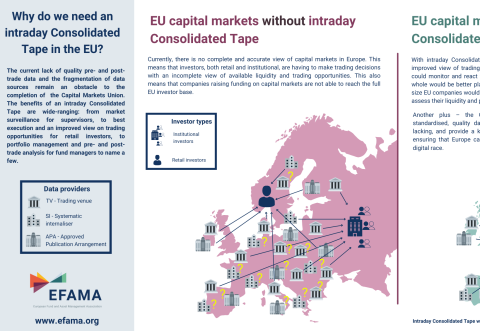
Visual | Why do we need a real-time Consolidated Tape in the EU?
The current lack of quality pre- and post-trade data and the fragmentation of data sources remain an obstacle to the completion of the Capital Markets Union. The benefits of a real-time Consolidated Tape are wide-ranging: from market surveillance for supervisors, to best execution and an improved view on trading opportunities for retail investors, to portfolio management and pre- and post-trade analysis for fund managers to name a few.
Publication

Capital Markets
Benchmarks
06 July 2021
3 Questions to Jean-Louis Schirmann on the use of EURIBOR
Q #1 How was Euribor impacted by the adoption of the Benchmark Regulation (BMR) and what are the relevant features of the reformed Euribor for investment managers?
Publication

Capital Markets
Benchmarks
30 June 2021
3 Questions to Christophe Binet on LIBOR Transition
Q #1 When will LIBOR phase out and which rates will be replacing it?
The London Interbank Offered Rate, also known as LIBOR®, is a widely-used index for short-term interest rates that is commonly found in
Past events




Contact

Deputy Director, Capital Markets and Digital