We commend the work that IOSCO has undertaken to date on this topic including the survey work and the summary findings in the form of the report currently under review. It is fair to say that the conclusions of the report and areas for further work gave rise to detailed discussions within our industry, yielding ultimately firm views on the priority areas that we support and see value in, and areas we felt were not reflected in the study and thereby building risk into margining models in future crisis scenarios. These areas are fur
Capital markets
Investment managers, acting on behalf of their retail and institutional clients, are among the largest investors in financial markets. They represent a key component of the market’s “buy-side” segment.
In representing the interests of its members on wholesale capital market issues, EFAMA advocates for fair, deep, liquid, and transparent capital markets, supported by properly regulated and supervised market infrastructure.
Related policy positions
Policy position

Capital Markets
27 January 2022
IOSCO Consultation on 'Review of margining practices'
Policy position

Capital Markets
EMIR
24 January 2022
ESMA consultation on the review of clearing thresholds under EMIR
For asset managers the main issue continues to be the reclassification of ETDs as OTCs as a result of the non-equivalence of UK regulated markets. While we understand that a review is legally mandated at this point in time, we do not see value in recalibrating the various thresholds or making changes to the calculation methodologies unless these are in the two areas we define below. Our main concern revolves around the fact that changes would carry significant compliance costs while making little impact on the population of counterparties and notional captured by the thresholds.
Policy position

Capital Markets
MIFID
22 December 2021
EFAMA’s response to ESMA’s Review of the MiFID II framework on best execution reports
This is a timely and necessary review to which we hope to contribute in a constructive manner. As already recognised in the consultation paper and in the MiFID Quick Fix proposal, RTS 27 and RTS 28 currently fall short of the objective of providing valuable and comparable datasets for investment managers and the investing public. We appreciate the present effort to revise reporting requirements to produce more meaningful reports.
Related news
Press Release

Capital Markets
28 May 2025
First industry-led conference discusses concrete policy actions to turn Europe into a global hub for digital assets
Yesterday, EFAMA hosted asset management firms from across Europe to discuss how tokenisation is reshaping the industry at the Redefining assets: tokenisation and the future of investment
Press Release

Capital Markets
Retail Investment
27 March 2025
Providing access to ISAs is key for turning European savers into investors
EFAMA emphasizes the importance of a bottom-up approach
Press Release

Capital Markets
Data
04 February 2025
European Stock Exchanges' Over-Reliance on Equity Market Data Revenues: Stifling Growth and Innovation
Rising data fees to offset declining trading revenue burden market participants with surging costs
Related publications
Infographic
Capital Markets
MIFID
Capital Markets Union
Data
06 October 2021
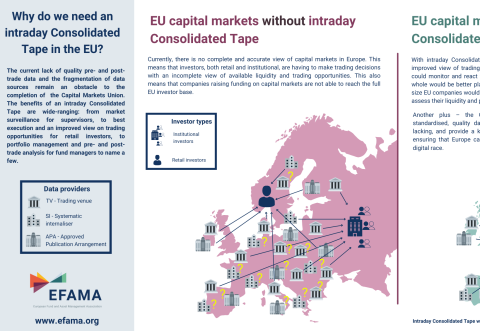
Visual | Why do we need a real-time Consolidated Tape in the EU?
The current lack of quality pre- and post-trade data and the fragmentation of data sources remain an obstacle to the completion of the Capital Markets Union. The benefits of a real-time Consolidated Tape are wide-ranging: from market surveillance for supervisors, to best execution and an improved view on trading opportunities for retail investors, to portfolio management and pre- and post-trade analysis for fund managers to name a few.
Publication

Capital Markets
Benchmarks
06 July 2021
3 Questions to Jean-Louis Schirmann on the use of EURIBOR
Q #1 How was Euribor impacted by the adoption of the Benchmark Regulation (BMR) and what are the relevant features of the reformed Euribor for investment managers?
Publication

Capital Markets
Benchmarks
30 June 2021
3 Questions to Christophe Binet on LIBOR Transition
Q #1 When will LIBOR phase out and which rates will be replacing it?
The London Interbank Offered Rate, also known as LIBOR®, is a widely-used index for short-term interest rates that is commonly found in
Past events



Contact

Deputy Director, Capital Markets and Digital