With 2021 drawing to a close, we wish you a safe and peaceful festive season. Join us in welcoming 2022 with hope and optimism.
On 1 February, Tanguy van de Werve, EFAMA's Director General has been invited to speak at the ESAs high-level conference on financial education and literacy. He will participate in the panel in a panel on 'Financial education and Capital Market Union' together with: Tatyana Panova, Head of Unit, Capital Market Union unit, European Commission (DG FISMA); Jean-Paul Servais, Chairman of the Belgian Financial Services and Markets Authority (FSMA) and vice chair of the IOSCO Board, and Aleksandra Mączyńska, Executive Director, Better Finance.

The European Fund and Asset Management Association (EFAMA) has released the 13th edition of its Asset Management in Europe report, which provides in-depth analysis of recent trends in the European asset management industry, focussing on where investment funds and discretionary mandates are managed in Europe.

We see great value in the creation of a consolidated tape to support Europe’s capital markets. However, we qualify that statement with a reminder that the framework for a successful consolidated tape should
i) address the known market failure around market data costs,
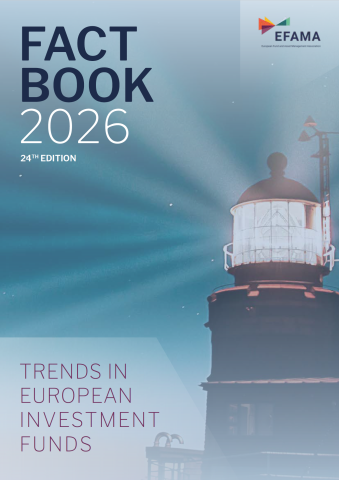
EFAMA today published its latest quarterly international statistics, tracking and analysing trends in worldwide regulated open-ended fund assets and flows for Q3 2021.
The main developments can be summarised as follows:
This year’s Investment Management Forum featured an incredible number of high-level speakers and thought-provoking discussions.
.png)
EFAMA sees the European Commission’s proposal for the creation of a European Single Access Point (ESAP) as a crucial step in addressing the limited availability and scattered nature of financial and sustainability-related entity information at EU level.
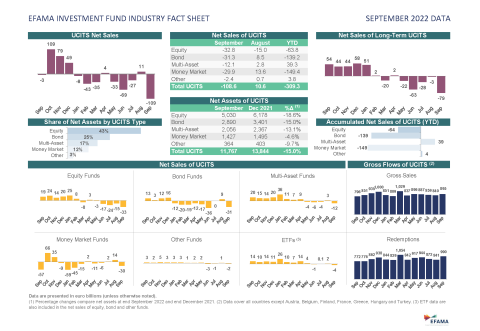
EFAMA has today published its latest quarterly European statistics, tracking and analysing trends in European regulated open-ended fund assets and net flows during Q3 2021.
The main developments through the quarter are as follows:
EFAMA has some concerns with ESMA’s clarifications. In the consultation paper (CP), ESMA seems to have a very broad interpretation of the ‘multilateral systems’ definition under MiFID II and states that ‘systems where trading interests can interact but where the execution of transactions is formally undertaken outside the system still qualify as a multilateral system and should be required to seek authorisation’ (paragraph 36).
We disagree with an extension of its scope to UCITS’ and AIFs’ management companies to the scope of the reporting requirements imposed by MiFIR, Art. 26. This extension would be in breach of the principle of proportionality, as:
Article 51(5) of the BMR provides that, unless the Commission has adopted an equivalence decision in relation to a particular third country, a third country administrator has been recognised or a third country benchmark has been endorsed, EU supervised entities may only use a third country benchmark in financial instruments, financial contracts and measurements of the performance of an investment fund that already reference the relevant benchmark prior to 31 December 2021.
EFAMA is grateful for the opportunity to comment on some messages included in the aforementioned roadmap. We believe that these comments should be made clear for all persons interested, especially to those who would like to participate in the upcoming public consultation.
Asset managers represent an important group of benchmark users, either in the case of index funds and exchange traded funds (ETFs) - where benchmarks are used as a target for index tracking funds - or in the case of the evaluation of an active manager’s performance - where the fund performance is measured against a selected index or a set of indices.
EFAMA, the voice of the European investment management industry, believes that, for retail clients, standardised disclosure of information can improve the comparability of financial products that promote environmental and/or social characteristics or have a sustainable objective. It will also contribute to the broader policy objectives of the Sustainable Finance Disclosures Regulation (SFDR) to enhance transparency towards end-investors, hold market participants accountable and fight greenwashing.

Discover the 6 reasons why your organisation should become a member of EFAMA.
Our members enjoy significant benefits including the opportunity to shape the industry positions, get first-hand access to regulatory and political intelligence, engage with industry peers and policymakers, and take part in EFAMA events.
Our three membership categories cater to the wide range of organisations that make up and support the investment management industry in Europe.