This article was published on the EFAMA blog on 24 March 2026.
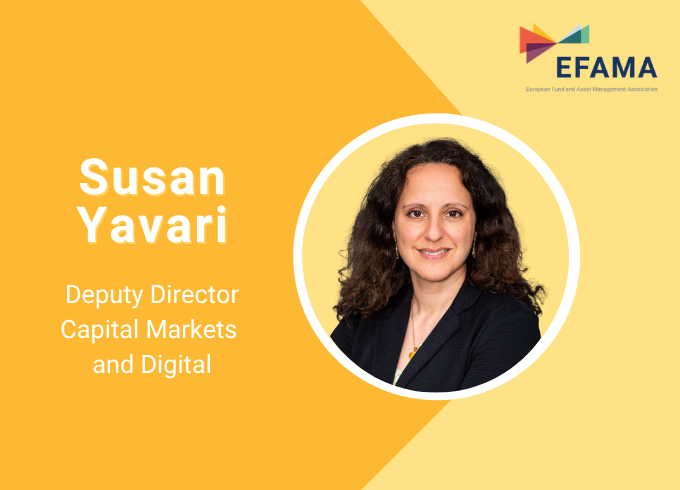
By Susan Yavari, Deputy Director for Capital Markets and Digital at EFAMA
(Disclaimer: these views are the author’s own and do not necessarily reflect agreed policy positions of EFAMA and its members)
The funny thing about the Consolidated Tape for financial market data is that it is not a tape at all.
With the latest review of MiFIR behind us (2024) and the secondary regulation put in place, we are on track to have a consolidated tape providing real-time market data for investors. Fund managers are very excited about this. Finally, Europe’s diverse trading landscape, comprised of incumbent stock exchanges and alternative trading venues will be captured in a single definitive data feed. Investors of all stripes, institutional, retail, global will have a consolidated view on the instruments they want to trade: What is the current best price? What quantity of shares are available at that price? Where do I trade this (we’ll come back to this one). If I buy all the shares offered at the best price, how much liquidity will be available at the next price level?
But as I mentioned earlier, it is not a tape that Europe will have when the Consolidated Tape launches sometime in 2026. It is better described as an electronic feed that delivers high-speed data to different users: trading platforms, computer terminals, algo engines.
It is called a tape because back in the 1970s when the US launched a similar service, consolidating data from different exchanges, it really was a physical tape. A narrow strip of paper continuously spewing out of terminals in banks. Traders would gather around these terminals, checking the paper strip for their stocks.
In Europe, with trading venues numbering in the hundreds, we have been discussing a legislative mandate to establish a consolidated tape since 2010. Sixteen years to bring to market an essential piece of market infrastructure is an awfully long time.
Is there a powerful special interest group that has slowed the adoption of a CT in Europe? Yes, there is. Securities exchanges worry that a tape will eat into the attractive revenue streams they make off the sale of their data in proprietary, individual feeds. Let’s break down what a CT might mean for exchange data revenues. The CT provider will redistribute revenues back to the providers of data. No one is getting data for free. The user pays. EuroCTP, the company that has won the contract to deliver the equity (and ETF) tape, recently published its rates. Banks and buy-side firms will pay for the use of the CT; only retail will get free use of the data via their brokers.
Also, the large majority of users today, portfolio managers, traders, brokers, will not be weaned off the proprietary data feeds just because the CT exists. The two will be consumed alongside one another: one (the proprietary feeds from the providers) delivers very low latency data, i.e speed , the other (the consolidated tape) provides a unified view of the markets.
But honestly, why are we even discussing this? Isn’t it clear that data trumps all? We live in an era where data is the most sought-after asset. Traders and portfolio managers on the buy-side need this data, their Smart Order Routing systems (SORs) need data, algo engines need data. Concretely, this means asset managers, pension funds, insurers, both inside and outside the EU, deciding: should I invest in the EU? Do I understand this market? Do I have the level of transparency and depth of data that I need to make informed investment decisions?
Now let’s get back to the CT in Europe. We are very close to launch. It has been a long journey. We all want the great things that the CT will deliver. EuroCTP, by the way, owned by Europe’s largest exchange groups, has distinguished itself as an agile new player, run with entrepreneurial flair and a connection with, and understanding of, its userbase.
Hmm, but guess what? A CT is designed to deliver relevant data in real-time, but the European tape wil not deliver this from the outset. Yes, it will tell users what the best bid and offer is for any given instrument at any given point (what we call pre-trade data), but the venue will not be revealed. CT users will know that Siemens, for instance, is trading at price X, for Y amount of shares, but they will not know if that price came from Deutsche Borse, Vienna Stock Exchange, CBOE, Acquis or elsewhere.
Yes you read that right. The CT will mask the venue where the quotes are coming from.
At a time when we are looking at the Savings and Investment Union, the sobering conclusions and calls to action of the Letta and Draghi reports, a very energized and hard-working European Commission, Member States that are asked to overlook small narrow sectoral interests in favour of building integrated, functioning and attractive capital markets, can we not take a minute to say let’s deliver the proper tape for Europe?
Or shall we let this slide, and cross our fingers, that this less optimal version of the tape, will still be met with overwhelming demand?
If you think that time is on our side then, by all means, let’s wait! Let’s not require the tape to carry complete data on pre-trade quotes. We are already so far removed from the time when the consolidated tape first made its appearance with clunky terminals clattering away in trading rooms, what is a few more years?