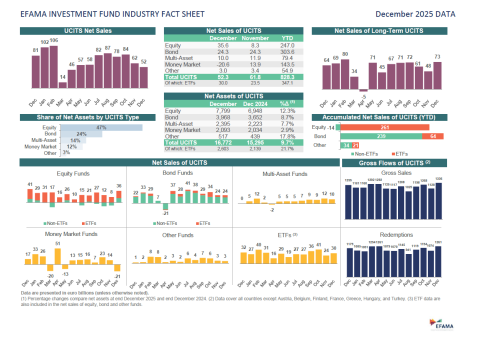

EFAMA’s latest Monthly Statistical Release for December allows a first overview and analysis of the full year 2025 for the European investment fund market. What we see is an incredibly strong year for EU-based funds, with large quantities of investment flowing into equity ETFs, bond UCITS and MMFs.
Thomas Tilley, Senior Economist at EFAMA, commented on the 2025 results: “With over EUR 800 billion in net sales, 2025 marked a record-breaking year for UCITS. Net inflows were robust across all main categories, with bond and equity funds accounting for the bulk. The rush into ETFs showed no signs of abating as these funds posted their third consecutive year of record-high net sales. At the same time, strong inflows into money market funds indicate that some investors adopted a more cautious stance during a year of geopolitical uncertainty and currency volatility.”
Tanguy van de Werve, Director General at EFAMA, commented: “The strong inflows into UCITS in 2025 demonstrate the continued success and resilience of the UCITS regulatory framework. Investors’ confidence in UCITS highlights the effectiveness of its robust governance, risk management, and investor protection standards. These results underscore the importance of preserving the stability of the framework and avoiding unnecessary regulatory changes that could disrupt an ecosystem that is clearly delivering for both investors and markets.”
The main developments in 2025 can be summarised as follows:
UCITS and AIFs recorded net inflows of EUR 873 billion in 2025, up from net sales of EUR 685 billion in 2024. Net assets of European investment funds grew by 7.4%, breaching the EUR 25 trillion threshold for the first time.
UCITS net sales reached a new record in 2025. Net inflows amounted to EUR 828 billion in 2025, higher than EUR 630 billion in 2024 and surpassing the previous 2021 high (EUR 813 billion).
Equity UCITS recorded strong net sales as stock markets saw solid returns despite some tariff turmoil. After strong net sales of EUR 147 billion in 2024, net sales surged to EUR 247 billion in 2025. Investors continued to prefer ETFs when investing in equity funds. Equity ETFs attracted a record EUR 261 billion in net new money, while non-ETF equity funds saw net outflows of EUR 14 billion.
Bond UCITS remained the top-selling UCITS category. Major central banks continued their rate cuts in 2025. This resulted in net inflows of EUR 304 billion into bond UCITS, higher than in 2024 (EUR 275 billion), but still lower than in 2017 (EUR 313 billion). In contrast to equity UCITS, non-ETF bond UCITS accounted for the bulk of inflows, attracting EUR 239 billion, while bond ETFs saw net sales of EUR 64 billion.
Multi-asset UCITS returned to positive territory after two years of net outflows. Net inflows totalled EUR 79 billion in 2025, a stark reversal from the EUR 40 billion in net outflows in 2024. This turnaround reflects a renewed appetite for multi-asset UCITS among certain investors seeking to diversify their portfolios and mitigate the risks of single-asset-class investing.
Money market funds (MMFs) saw strong net inflows thanks to their role as a cash alternative. Exceptional 2024 inflows of EUR 226 billion were largely driven by an inverted yield curve. Despite yield curves normalising by the end of 2024, robust MMF inflows amounting to EUR 143 billion persisted in 2025, mainly driven by investors using MMFs as a ‘safe haven’ cash alternative, while maintaining a wait-and-see approach amid geopolitical uncertainty.
A third consecutive record year for ETFs in 2025. Net UCITS ETF sales soared to EUR 347 billion, far surpassing the 2024 record of EUR 269 billion. ETFs remain the preferred investment vehicle for investors seeking exposure to global and regional stock markets.
AIF inflows remained muted. Net sales totalled EUR 45 billion, below the EUR 55 billion recorded in 2024. AIFs follow a different sales pattern than UCITS, as their investor base is predominantly institutional. Multi-asset AIFs led net sales with EUR 53 billion, followed by other AIFs at EUR 30 billion. In contrast, equity AIFs saw net outflows of EUR 44 billion, largely due to continued transitions by Dutch pension funds from AIF structures into segregated mandates.
Hailin Yang, Senior Data Analyst at EFAMA, commented on the December 2025 figures: “Net sales of long-term UCITS remained strong in December 2025, as financial markets generally ended the year on a high note.”
Analysing the data for December 2025, EFAMA highlighted the following:
Net sales of UCITS and AIFs totalled EUR 81 billion, up from EUR 66 billion in November 2025.
UCITS recorded net inflows of EUR 52 billion, compared to EUR 62 billion in November 2025.
Long-term UCITS (UCITS excluding money market funds) recorded EUR 73 billion of net sales, up from EUR 48 billion in November 2025. Of these, ETF UCITS saw net inflows of EUR 30 billion, compared to EUR 24 billion in November 2025.
Equity funds registered net inflows of EUR 36 billion, up from EUR 8 billion in November 2025.
Net sales of bond funds amounted to EUR 24 billion, a level close to that recorded in November 2025.
Multi-asset funds recorded net inflows of EUR 10 billion, down from EUR 12 billion in November 2025.
UCITS money market funds registered net outflows of EUR 21 billion, compared to net inflows of EUR 14 billion in November 2025.
AIFs recorded net inflows of EUR 29 billion, up from EUR 5 billion in November 2025.
Total net assets of UCITS and AIFs decreased slightly by 5 basis points to EUR 25.2 trillion.
-ENDS-
Notes to editors
About the Monthly EFAMA Investment Fund Industry Fact Sheet:
The Fact Sheet is published by EFAMA monthly and presents net sales and net assets data for UCITS and AIFs for 29 European countries: Austria, Belgium, Bulgaria, Cyprus, Czech Republic, Denmark, Finland, France, Germany, Greece, Hungary, Ireland, Italy, Liechtenstein, Luxembourg, Malta, Netherlands, Norway, Poland, Portugal, Romania, Slovakia, Slovenia, Spain, Sweden, Switzerland, Turkey, and United Kingdom.
For further information, please contact:
Hayley McEwen
Head of communication & membership development