Press Release

Capital Markets
Data
04 February 2025

EFAMA has submitted its response to ESMA’s consultation on the Active Account Requirements (AAR). Our industry stands ready to implement the AAR by June 2025... However, we have strong reservations about the heavy and redundant reporting requirements.

EFAMA has published its latest Monthly Statistical Release for November 2024.

European Commission’s Omnibus initiative should also be used to make CSRD consistent with SFDR

Today the European Securities and Markets Authorities (ESMA) hosted the T+1 Governance Launch Meeting to present the arrangements for driving the move to the reduction of default settlement cycles to T+1 for EU securities markets.
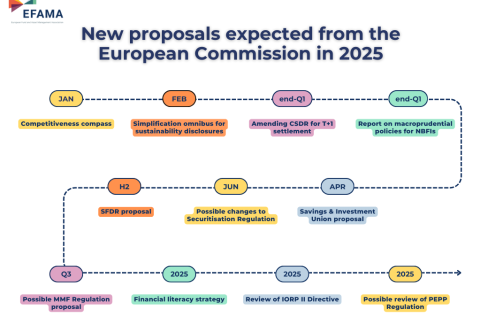
The new European Commission is under pressure to act quickly and decisively and are moving full steam ahead with their policy priorities in 2025.
We can expect numerous new regulatory proposals in areas of importance for asset managers, including simplification, boosting competitiveness, financial stability and a new Savings & Investment Union proposal.
The focus on competitiveness and regulatory simplicity is definitely a step in the right direction after many years of ballooning regulatory complexity.

EFAMA has published its latest Monthly Statistical Release for October 2024.
Thomas Tilley, Senior Economist at EFAMA, commented: “2024 is shaping up to be another record-breaking year for ETFs, with almost EUR 200 billion in net sales over the first ten months of the year.”

EFAMA has published today the latest edition of its Market Insights series, titled “The sectoral performance of active and passive UCITS - is a simple measure enough?”. This publication compares the net performance of different categories of equity UCITS funds over the last ten years (2014-2023).

EFAMA has published its latest International Quarterly Statistical Release for Q3 2024.

This article was first published in the 2024 Asset Management Report on 12 December 2024.
I am delighted to present the 16th edition of EFAMA’s Asset Management Report, which offers a comprehensive analysis of the current state and recent trends in the European asset management industry.

EFAMA has today published the 16th edition of its Asset Management in Europe report, which provides in-depth analysis of recent trends in the European asset management industry.
Key findings of the report include:

This is the 16th edition of our ‘Asset Management in Europe’ report. The report provides an in-depth analysis of recent trends in the European asset management industry.
Some of the main findings include: