EFAMA places huge importance on this revision of ESMA’s suitability guidelines, as they spell out in detail how investors can invest in sustainable investment products. If they are well designed, the guidelines have the potential to significantly boost capital flows towards sustainable investments; a goal that the European fund industry strongly supports.
EFAMA views and recommendations on ESMA's consultation on the review of EMIR RTS on APC margin measures
The European Fund and Asset Management Association (EFAMA) welcomes the opportunity to respond to this important review of RTS 153/2013 and accompanying guidelines, in light of the procyclicality witnessed during the peak volatility of the Covid crisis. European CCPs already have standard anti-procyclicality tools in their rulebooks and this did lead to less volatile moves in margin in Europe versus other jurisdictions.

EFAMA's comments on EC’s Pillar Two proposal
With the release of this proposal, the Commission is replicating the OECD / BEPS Inclusive Framework (OECD) Pillar Two Global Anti-Base Erosion (GloBE) Model Rules that came live in December 2021 and addresses how Member States will implement them in a coherent and consistent way across the EU. The work of the Commission and the alignment with the work of the OECD / BEPS Inclusive Framework are to be welcomed.
EFAMA's comments on EC’s Un-Shell proposal
EFAMA fully supports the Commission’s initiatives to fight tax avoidance and aggressive tax planning. The work of the technical teams that acknowledged our industry’s special requirements and the proposal of carve-out rules to protect investment structures and end-investors are, to a certain extent, to be welcomed.
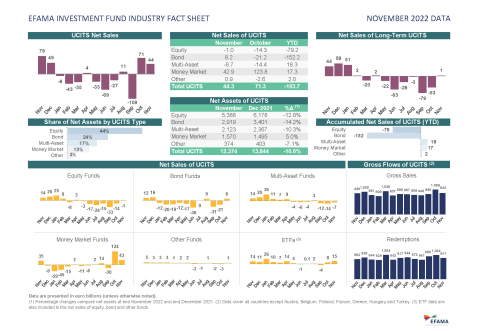
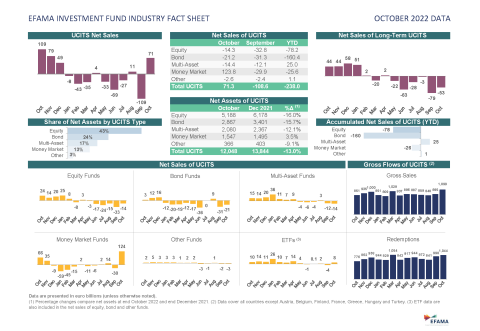
UCITS equity funds remained in high demand in January, contrary to bond funds
More must be done to improve European citizens' financial literacy
More must be done to improve European citizens’ financial literacy
The European Asset Management Industry's Engagement in Financial Education Initatives
EFAMA Report: more must be done to improve European citizens' financial literacy.
This is evidenced in the second edition of EFAMA's report, "The European Asset Management Industry's Engagement in Financial Education Initiatives", released in March 2022.
The report, prefaced by Commissioner Mairead McGuinness, is divided into three parts.
EFAMA's response to the EU Commission's targeted consultation on options to enhance the suitability and appropriateness assessments
EFAMA appreciates the opportunity to share our views on the European Commission’s consultation on enhancements to the suitability and appropriateness assessments forming part of the wider, upcoming Retail Investment Strategy.
Net sales of worldwide funds exceeded EUR 1 trillion in Q4 2021
The European Fund and Asset Management Association (EFAMA) has today published its International Quarterly Statistical Release regarding the developments in the worldwide investment fund industry during the fourth quarter of 2021.
FinDatEx publishes EET v1.0 and EMT v4.0
The European ESG Template (EET) is meant to facilitate the necessary exchange of data between product manufacturer and distributor for the purpose of fulfilling ESG-related regulatory requirements contained in the SFDR, relevant provisions of the Taxonomy Regulation, and the relevant delegated acts complementing MiFID II and IDD. The EET V1 is based on the regulatory situation on the day of publication and will be reviewed regularly depending on the evolving regulation, and at least confirmed annually. With regard to the MiFID target market, the EET interacts with the EMT V4.
US mutual funds are not necessarily cheaper than UCITS | EFAMA Market Insights Issue #8
EFAMA released today issue number eight of its Market Insights series titled 'The Costs of UCITS and US Mutual Funds - We can only compare like with like'. This
EFAMA’s position on the EC's review of the AIFM and UCITS directives
We welcome the targeted approach of the Commission in its review, recognising the overall success of the frameworks over the past decade.