Capital markets
Investment managers, acting on behalf of their retail and institutional clients, are among the largest investors in financial markets. They represent a key component of the market’s “buy-side” segment.
In representing the interests of its members on wholesale capital market issues, EFAMA advocates for fair, deep, liquid, and transparent capital markets, supported by properly regulated and supervised market infrastructure.

Joint letter on open Access and Interoperability in Cash Equities Clearing

EFAMA response to ESMA’s call for evidence on the Structure of European Equity Markets
Latest Parliament report takes the Market Integration and Supervision Package in the wrong direction
Turning ESMA into an extra supervisor for asset managers is unwarranted, a major distraction, and runs contrary to the EU competitiveness and simplification agendas
What does the High-Level Forum report on CMU mean for our industry?
For our 3rd issue, we spoke with Sheila Nicoll (Schroders) and Alexander Schindler (Union Investment), both members of the High-Level Forum on the Capital Markets Union, who kindly shared their thoughts with us on the High-Level Forum report and what it means for the asset management industry.
EFAMA calls for changes to investor protection rules in MIFID II / MIFIR Review
EFAMA has submitted its  response to the European Commission's consultations on the review of the MIFID II / MIFIR regulatory framework, where it has outlined its recommendations on investor protection and capital markets and infrastructure.
EFAMA's Director General Tanguy van de Werve commented:
Market data costs
In this first issue, we spoke with Rudolf Siebel, the Chair of EFAMA’s Trading, Trade Reporting & Market Infrastructures Standing Committee, who shared his thoughts with us on Market Data Costs.

Buy-side use-cases for a real-time consolidated tape
A real-time consolidated tape, provided it is made available at a reasonable cost, will bring many benefits to European capital markets. A complete and consistent view of market-wide prices and trading volumes is necessary for any market, though this is especially true for the EU where trading is fragmented across a large number of trading venues. A real-time consolidated tape should cover equities and bonds, delivering data in ‘as close to real-time as technically possible’ after receipt of the data from the different trade venues.
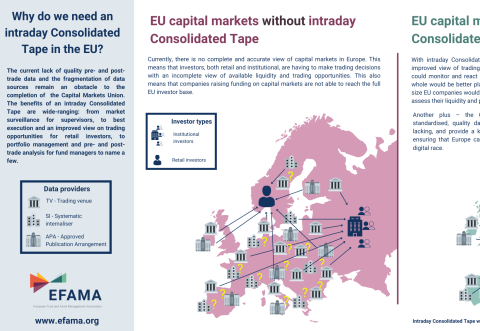
Visual | Why do we need a real-time Consolidated Tape in the EU?
The current lack of quality pre- and post-trade data and the fragmentation of data sources remain an obstacle to the completion of the Capital Markets Union. The benefits of a real-time Consolidated Tape are wide-ranging: from market surveillance for supervisors, to best execution and an improved view on trading opportunities for retail investors, to portfolio management and pre- and post-trade analysis for fund managers to name a few.

3 Questions to Jean-Louis Schirmann on the use of EURIBOR
Q #1 How was Euribor impacted by the adoption of the Benchmark Regulation (BMR) and what are the relevant features of the reformed Euribor for investment managers?