List of recommendations show what is needed to ensure a successful tape.
In the modern economy, data is increasingly becoming a strategic asset. This is particularly true for the asset management industry, where data forms the backbone of the daily activities and internal processes necessary to guarantee best practices in portfolio management.
Asset managers are major users of a variety of data, including market data, index data and, increasingly, ESG data. EFAMA advocates for, and seeks to support members’ access to, high-quality, standardised and comparable data at a fair price. EFAMA also encourages the creation of a well-structured, reasonably priced consolidated tape fed by all trading venues and systematic internalisers for all financial instruments.

List of recommendations show what is needed to ensure a successful tape.

The competitiveness of EU asset managers is heavily reliant on the quality, stability, cost-efficiency and predictability of the rules under which they operate.
As part of our recommendations to make competitiveness a central element of all EU policies, we highlight the importance of tackling anti-competitive market practices and the ever-increasing cost of various types of data.

EFAMA sees the European Commission’s proposal for the creation of a European Single Access Point (ESAP) as a crucial step in addressing the limited availability and scattered nature of financial and sustainability-related entity information at EU level.

The European Fund and Asset Management Association (EFAMA) has today published its latest monthly Investment Fund Industry Fact Sheet, which provides net sales data of UCITS and AIFs for February 2020*.
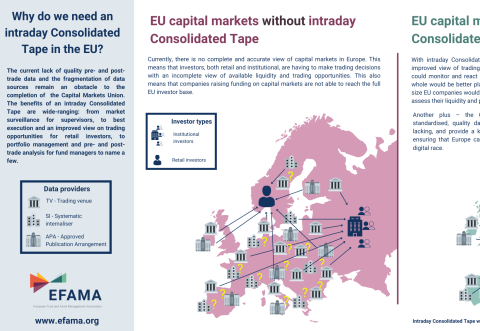
The current lack of quality pre- and post-trade data and the fragmentation of data sources remain an obstacle to the completion of the Capital Markets Union. The benefits of a real-time Consolidated Tape are wide-ranging: from market surveillance for supervisors, to best execution and an improved view on trading opportunities for retail investors, to portfolio management and pre- and post-trade analysis for fund managers to name a few.

A key purpose of the financial system is to allocate capital and risk in a manner that supports sustainable economic development and growth, including through the provision of financing, investment and hedging products. Financial benchmarks/indices are fundamental to the functioning of financial markets and are widely used in both retail and wholesale markets. In particular, benchmarks are a valuable tool helping market participants to set prices, measure performances, or work out amounts payable under financial contracts or instruments.
The report looks at the major trends in the ESG UCITS market, the impact of the coronavirus pandemic, and the behaviour of ESG and non-ESG funds.