


UCITS equity funds remained in high demand in January, contrary to bond funds






UCITS equity funds remained in high demand in January, contrary to bond funds
This is evidenced in the second edition of EFAMA's report, "The European Asset Management Industry's Engagement in Financial Education Initiatives", released in March 2022.
The report, prefaced by Commissioner Mairead McGuinness, is divided into three parts.

EFAMA appreciates the opportunity to share our views on the European Commission’s consultation on enhancements to the suitability and appropriateness assessments forming part of the wider, upcoming Retail Investment Strategy.

The European Fund and Asset Management Association (EFAMA) has today published its International Quarterly Statistical Release regarding the developments in the worldwide investment fund industry during the fourth quarter of 2021.

The European ESG Template (EET) is meant to facilitate the necessary exchange of data between product manufacturer and distributor for the purpose of fulfilling ESG-related regulatory requirements contained in the SFDR, relevant provisions of the Taxonomy Regulation, and the relevant delegated acts complementing MiFID II and IDD. The EET V1 is based on the regulatory situation on the day of publication and will be reviewed regularly depending on the evolving regulation, and at least confirmed annually. With regard to the MiFID target market, the EET interacts with the EMT V4.
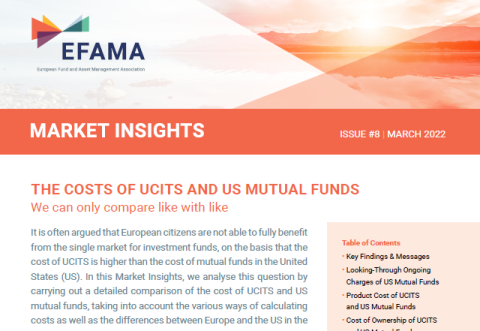
EFAMA released today issue number eight of its Market Insights series titled 'The Costs of UCITS and US Mutual Funds - We can only compare like with like'. This

We welcome the targeted approach of the Commission in its review, recognising the overall success of the frameworks over the past decade.





EFAMA welcomes the FSB recommendation that jurisdictions develop domestic frameworks to monitor and mitigate the build-up of leverage. These analytical frameworks should take a holistic approach and be empirically driven. The main systemic risk stemming from leverage is the imbalance between liquidity demand and supply during periods of stress, not the (collective) default of non-bank financial intermediaries.

In its response to IOSCO’s consultation on the revised recommendations for liquidity risk management for collective investment schemes, EFAMA welcomes the fact that IOSCO recognises aspects essential for proper risk management (e.g., asset managers’ primary responsibility and the absence of one-size-fits-all approaches).

EFAMA has submitted its response to ESMA’s consultation on the Active Account Requirements (AAR). Our industry stands ready to implement the AAR by June 2025... However, we have strong reservations about the heavy and redundant reporting requirements.

In its response to the Commission’s consultation on assessing the adequacy of macroprudential policies for NBFI, EFAMA stresses that Europe needs more holistic and rigorous analyses to determine where financial stability risks lie. Unfortunately, even though investment funds have proven resilient in recent years despite frequent market disruptions, the consultation focuses on the asset management industry.
Discover the 6 reasons why your organisation should become a member of EFAMA.
Our members enjoy significant benefits including the opportunity to shape the industry positions, get first-hand access to regulatory and political intelligence, engage with industry peers and policymakers, and take part in EFAMA events.
Our three membership categories cater to the wide range of organisations that make up and support the investment management industry in Europe.