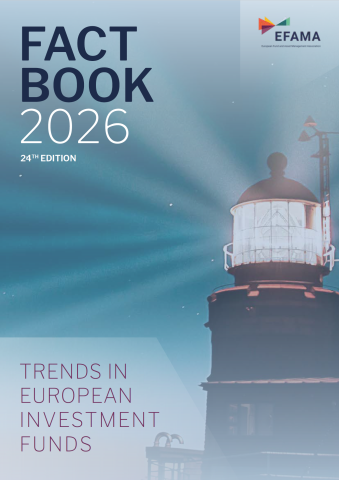



EFAMA has today published its latest monthly Investment Fund Industry Fact Sheet, which provides net sales data on UCITS and AIFs for September 2023, at European level and by country of fund domiciliation.
Despite the growing interest and importance of sustainable investing, most EU citizens often find it difficult to navigate this relatively new investment landscape. To empower them in making investment decisions which support their personal values, EFAMA today launched its new brochure “Sustainable investing explained in 9 questions”.

EFAMA launches its new brochure "Sustainable investing explained in 9 questions".
Despite the growing interest and importance of sustainable investing, most EU citizens often find it difficult to navigate this relatively new investment landscape.

In the brochure we explore :
EFAMA is pleased to release a leaflet entitled “Retail Investment Strategy: positive elements for European investors and ones that should be reconsidered.” This document outlines the needs of EU investors, how the European Commission’s proposal is expected to help them, and what still needs to be adjusted.

The European Commission’s proposal for a Retail Investment Strategy is currently being debated within the European Parliament and Council. As a contribution to this discussion, EFAMA have produced a short leaflet which summarises the needs of EU retail investors, what the proposal gets right, and alternative proposals to consider, with a special focus on disclosures and advice.

EFAMA has released today a new issue of its Market Insights series titled “UCITS ETFs: A growing market in volatile times”.

As the US moves to a T+1 settlement cycle from May 2024, the settlement mismatch between the US and EU will raise operational challenges as well as, we suspect, market structure changes. But another direct consequence of the mismatch will be in the enforcement of current EU regulation. In this paper, we identify those scenarios where EU rules will be tested, suggest the scope of that impact and ask policymakers to explore how the regulatory impacts of US T+1 can be mitigated.
As the EU Member States conclude technical discussions around the AIFMD & UCITS review, EFAMA would like to congratulate the European Commission and the co-legislators for keeping the key elements of both Directives intact during their review. These frameworks lie at the core of a well-functioning and resilient funds market and this agreement is a welcome step forward for the funds industry, investors and the Capital Markets Union project.
EFAMA welcomes the opportunity to provide comments to the ESMA Consultation Paper on the draft technical standards under the Benchmark Regulation. EFAMA also welcomes a number of clarifications that ESMA is providing in this Consultation since its previous Discussion Paper.
EFAMA supports every efforts made to enhance financial markets regulation which reinforces the stability and the transparency of the financial system.
In that perspective, EFAMA welcomes the opportunity to comment on the ESMA consultation paper on the Draft RTS and ITS under SFTR and amendments to related EMIR RTS.
Prior to replying to the consultation, we wish to make the following general remarks
EFAMA, welcomes the opportunity to comment on the ESMA Discussion Paper (“DP”) on the trading obligation for derivatives under MiFIR.
As a principle, EFAMA supports every effort made to enhance financial market regulation which reinforces the stability of the financial system, of which MiFIR is an important part.
Prior to replying to the consultation, we wish to make the following general remarks.
EFAMA welcomes the opportunity to respond to the European Commission’s consultation envisaging the review of the EU macro-prudential policy framework. The consultation paper emphasises the review of the existing prudential framework built around the systemic nature of credit institutions and at the cornerstone of which lies the CRD/CRR, accompanied by the ESRB Regulation and the foundation of a Single Supervisory Mechanism (SSM) for a Banking Union, in turn revolving around the ECB.
EFAMA welcomes the opportunity to provide its comments on the Good Practices to be adopted by IOSCO for the Termination of Investment Funds. We agree that the decision to terminate a fund can have significant impact on investors in terms of the costs associated with such an action, or the ability for investors to redeem their holdings during the termination process. In this regard, even in the context of a fund’s voluntary termination, asset managers must abide by their fiduciary obligation to act in the best interest of their investors.
Better Finance and EFAMA have always been strong supporters of the “PRIIPs1 ” Key Information Document (“KID”), seeing it as a powerful instrument for retail investors to enable sound investment choices by allowing easier comparisons within a wide range of investment products. In order for this to happen, the rules defining the detailed contents of the PRIIPs KID must be correctly calibrated so that investors are given meaningful, comprehensible and comparable information.

Discover the 6 reasons why your organisation should become a member of EFAMA.
Our members enjoy significant benefits including the opportunity to shape the industry positions, get first-hand access to regulatory and political intelligence, engage with industry peers and policymakers, and take part in EFAMA events.
Our three membership categories cater to the wide range of organisations that make up and support the investment management industry in Europe.