EFAMA welcomes this opportunity to comment on the review of the provisions within the Short Selling Regulation. We have limited our responses to those questions of most relevance to our membership.
Capital markets
Investment managers, acting on behalf of their retail and institutional clients, are among the largest investors in financial markets. They represent a key component of the market’s “buy-side” segment.
In representing the interests of its members on wholesale capital market issues, EFAMA advocates for fair, deep, liquid, and transparent capital markets, supported by properly regulated and supervised market infrastructure.
Related policy positions
Policy position

Capital Markets
19 November 2021
ESMA Consultation on the review of certain aspects of the short selling regulation
Policy Position

Capital Markets
EMIR
16 September 2021
UK clearing house equivalence - request from nine trade associations
Nine associations (AFME, AIMA, EAPB, EBF, EFAMA, FIA, ICI, ISDA, SIFMA AMG) welcome the Commission's decision to grant a time-limited equivalence decision in respect of UK CCPs. However, when this time-limited equivalence decision expires on 30 June 2022, there remains a significant risk of disruption to clearing for EU firms and to their access to global markets.
Policy Position
Capital Markets
CSDR
15 July 2021
Joint association letter on the CSDR Settlement Discipline implementation timeline
On 14 July 2021, sixteen trade associations, representing buy-side, sell-side and market infrastructures, wrote to ESMA and the European Commission regarding the timeline for implementation of the mandatory buy-in rules as part of the CSDR Settlement Discipline Regime.
The Joint Associations welcome the Report from the Commission on the CSDR Review published in July 2021 and fully support the Commission’s intention to consider amendments to the mandatory buy-in regime, subject to an impact assessment.
Related news
Policy Position

Capital Markets
CSDR
22 December 2021
Industry Approach to CSDR Settlement Discipline Regime
The Joint Associations1 welcome clarification from ESMA that national competent authorities are expected not to prioritise supervisory actions in relation to the application of the CSDR buy-in regime.2
Policy Position

Capital Markets
MIFID
15 December 2021
Joint Statement on EU Commission proposal for revised Market in Financial Instrument Regulation (MiFIR)
We see great value in the creation of a consolidated tape to support Europe’s capital markets. However, we qualify that statement with a reminder that the framework for a successful consolidated tape should
i) address the known market failure around market data costs,
Press Release

Capital Markets
MIFID
Capital Markets Union
25 November 2021
EFAMA welcomes proposal on affordable consolidated tape - The association continues to urge action on market data costs
EFAMA is pleased to read today the details of a robust MiFIR proposal from the European Commission addressing key areas of reform around the creation of a consolidated tape (CT), along with adjustments to transparency requirements on trading.
Related publications
Infographic
Capital Markets
MIFID
Capital Markets Union
Data
06 October 2021
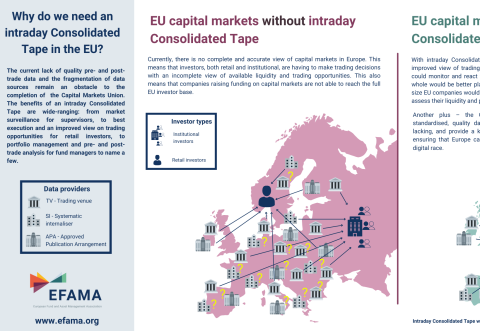
Visual | Why do we need a real-time Consolidated Tape in the EU?
The current lack of quality pre- and post-trade data and the fragmentation of data sources remain an obstacle to the completion of the Capital Markets Union. The benefits of a real-time Consolidated Tape are wide-ranging: from market surveillance for supervisors, to best execution and an improved view on trading opportunities for retail investors, to portfolio management and pre- and post-trade analysis for fund managers to name a few.
Publication

Capital Markets
Benchmarks
06 July 2021
3 Questions to Jean-Louis Schirmann on the use of EURIBOR
Q #1 How was Euribor impacted by the adoption of the Benchmark Regulation (BMR) and what are the relevant features of the reformed Euribor for investment managers?
Publication

Capital Markets
Benchmarks
30 June 2021
3 Questions to Christophe Binet on LIBOR Transition
Q #1 When will LIBOR phase out and which rates will be replacing it?
The London Interbank Offered Rate, also known as LIBOR®, is a widely-used index for short-term interest rates that is commonly found in


Contact

Deputy Director, Capital Markets and Digital