


The European Fund and Asset Management Association (EFAMA) has today published its latest monthly Investment Fund Industry Fact Sheet, which provides net sales data of UCITS and AIFs for June 2020.






The European Fund and Asset Management Association (EFAMA) has today published its latest monthly Investment Fund Industry Fact Sheet, which provides net sales data of UCITS and AIFs for June 2020.
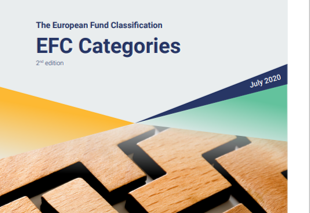
EFAMA published today the second edition of the brochure 'The European Fund Classification EFC Categories' to adapt the classification criteria to recent market evolutions. The European Fund Classification (EFC) is a pan-European classification system of investment funds, which is maintained by a Task Force of EFAMA.
Report highlights developments in the European fund industry in 2019 and shines a spotlight on the growing market for cross border funds.
The European Fund and Asset Management Association (EFAMA), has published its 2020 industry Fact Book. The 2020 Fact Book provides an in-depth analysis of trends in the European fund industry as well as international level, focusing on the U.S., other advanced economies and emerging markets.

The European Fund and Asset Management Association (EFAMA), has today published its latest International Statistical Release describing the trends in worldwide investment fund industry in the first quarter of 2020*.
Worldwide regulated open-ended fund assets decreased by 10.8 percent to EUR 47.1 trillion in the first quarter of 2020. Worldwide net cash flow to all funds amounted to EUR 617 billion, compared to EUR 808 billion in the fourth quarter of 2019.

In a report released today, the International Council of Securities Associations (ICSA), the European Fund and Asset Management Association (EFAMA), and the Managed Funds Association (MFA) call for the implementation of internationally recognized principles to address excessively high market data fees and unfair licensing provisions.

The European Fund and Asset Management Association (EFAMA) has today published its Quarterly Statistical Release describing the trends in the European investment fund industry in the first quarter of 2020 with key data and indicators for each EFAMA member countries.

Funds face unique challenges in performing intermediary oversight, and especially so because of MiFID II requirements, changing regulatory landscapes, and the absence of an industry agreed-upon standard between funds and their distribution channels. To help address these challenges, a dedicated working group developed a uniform due diligence questionnaire (DDQ) that will serve as the standard for investment funds (UCITS and AIFs) in performing onboarding and ongoing oversight of distribution channels.

EFAMA has submitted its  response to the European Commission's consultations on the review of the MIFID II / MIFIR regulatory framework, where it has outlined its recommendations on investor protection and capital markets and infrastructure.
EFAMA's Director General Tanguy van de Werve commented:



A flawed review process not tackling the heart of the issue
EFAMA has always made it clear that a revision of the PRIIPs Regulatory Technical Standard (RTS) falls short of conducting a proper Level 1 review. A review that is explicitly required by the Level 1 Regulation and is overdue for more than one year.

EFAMA supports the main objectives of CSDR to increase the safety and efficiency of securities settlement, including:
- Shorter settlement periods,
- Prudential and supervisory requirements for CSDs and other institutions providing banking services ancillary to securities settlement,
- The imposition of a penalty regime under CSDR as an important step towards improving settlement efficiency in European capital markets.

The AIFMD is one of the pillars of EU regulation for investment funds, which will be crucial to the development of the Capital Markets Union (CMU) and the post Covid-19 economic recovery in the European Union.

EFAMA firmly supports the Commission’s proposed amend of the ELTIF Regulation, in line with its recently revamped “new” CMU.

- Asset managers represent an important group of benchmarks’ users. In this context, EURIBOR rate is used by investment funds across all kinds of asset classes and financial instruments, as well as a benchmark for measuring fund performance, driving fee calculations and determining asset allocation.
- The identification of fallback rates for the contract with reference to EURIBOR are essential for asset managers and a stable and permanent approach would make the fallback clauses more robust and ensure further transparency.

EFAMA welcomes this ESMA initiative and we agree with the conclusions in the ESMA Report that there is an overall need to strengthen the laws applicable to data in connection with the MiFIDII/MiFIR Review, aside the implementation of a Consolidated Tape . We consider that the draft Guidelines will further strengthen the MiFID level 1 and level 2 measures and will foster the establishment of a cost-based approach for market data procurement. Therefore, we would be in favour of turning the proposed guidelines into binding regulation.
Discover the 6 reasons why your organisation should become a member of EFAMA.
Our members enjoy significant benefits including the opportunity to shape the industry positions, get first-hand access to regulatory and political intelligence, engage with industry peers and policymakers, and take part in EFAMA events.
Our three membership categories cater to the wide range of organisations that make up and support the investment management industry in Europe.