


EFAMA has published its response to a consultation on the draft delegated act under Article 8 of the Taxonomy.




EFAMA has published its response to a consultation on the draft delegated act under Article 8 of the Taxonomy.
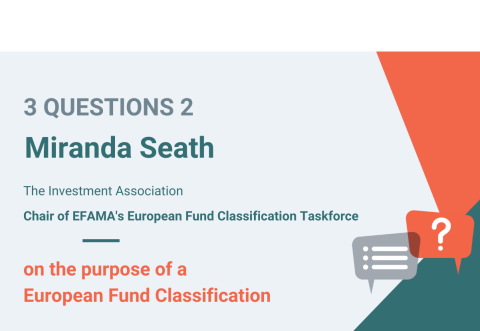
In issue seven of our popular series, we spoke with Miranda Seath (the Investment Association), Chair of the EFAMA European Fund Classification Taskforce, who kindly explained to us the purpose of the European Fund Classification, what the objectives are and what has already been achieved.

EFAMA has today published its Investment Fund Industry Fact Sheet for the first quarter of 2021, including information on owners of investment funds in Europe and their net purchases of funds during the fourth quarter of 2020.
The main developments through the quarter are as follows:

EFAMA’s 2021 Fact Book, “Trends in European Investment Funds”, will be published at the end of June.
As in previous years, this year’s Fact Book provides an extensive analysis of key developments in the investment fund industry, inside and outside Europe.

EFAMA has published its response to the European Commission’s targeted consultation on the supervisory convergence and the Single Rule Book, focusing on three areas for improvement.

The European Fund and Asset Management Association (EFAMA) has today published its latest monthly Investment Fund Industry Fact Sheet, which provides data on UCITS and AIFs sold in March 2021, at European level and by country of fund domiciliation.

EFAMA has published its response to the joint European Supervisory Authorities (ESAs) consultation on taxonomy-related sustainability disclosures in the Sustainable Finance Disclosure Regulation (SFDR).

EFAMA replied to IASB’s Request for Information on the Post-Implementation Review of IFRS 10, 11 and 12. We are delighted to see an investment entity within the funds industry being acknowledged and catered for in IFRS. The development of the consolidation standards was a very welcomed development in the asset management world.



Ever since the term “shadow banking” has emerged from the FSB’s working circles in the immediate aftermath of the 2008 global financial crisis[1], our association has consistently argued that its use as a reference to regulated asset management companies and their funds is inaccurate and mis-leading.

Andreas Stepnitzka, EFAMA Deputy Director, Regulatory Policy, comments:

The Commission aims to present a legislative proposal to address the tax-induced debt-equity bias, also to support the action plan for the Capital Markets Union and to encourage companies to finance their investment through equity contributions rather than through debt financing.

EFAMA provided high-level comments to the Commission’s consultation on the potential review of the Directive on Distance Marketing of Consumer Financial Services.
We agree with the Commission’s interpretation that the Directive is seen as a “safety net” for financial services not already subject to product-specific legislation. Fund and asset managers are already subject to various, more stringent and detailed sectoral legislations, such as (but not limited to) UCITS, AIFMD and MiFID as well as the (more recent) Cross-Border Fund Distribution Directives.

The asset management industry recognises the much-needed adoption of mandatory European sustainability reporting standards under the Corporate Sustainability Reporting Directive (CSRD) proposal. Insufficient availability of meaningful, comparable, reliable, and public Environmental, Social and Governance (ESG) data is a key impediment to realising the full potential of the EU's sustainable finance regulatory framework. Financial market participants' sustainable investments need to be driven by real, verifiable and reported ESG metrics of company's activities and financial risks.

Nine associations (AFME, AIMA, EAPB, EBF, EFAMA, FIA, ICI, ISDA, SIFMA AMG) welcome the Commission's decision to grant a time-limited equivalence decision in respect of UK CCPs. However, when this time-limited equivalence decision expires on 30 June 2022, there remains a significant risk of disruption to clearing for EU firms and to their access to global markets.
Discover the 6 reasons why your organisation should become a member of EFAMA.
Our members enjoy significant benefits including the opportunity to shape the industry positions, get first-hand access to regulatory and political intelligence, engage with industry peers and policymakers, and take part in EFAMA events.
Our three membership categories cater to the wide range of organisations that make up and support the investment management industry in Europe.