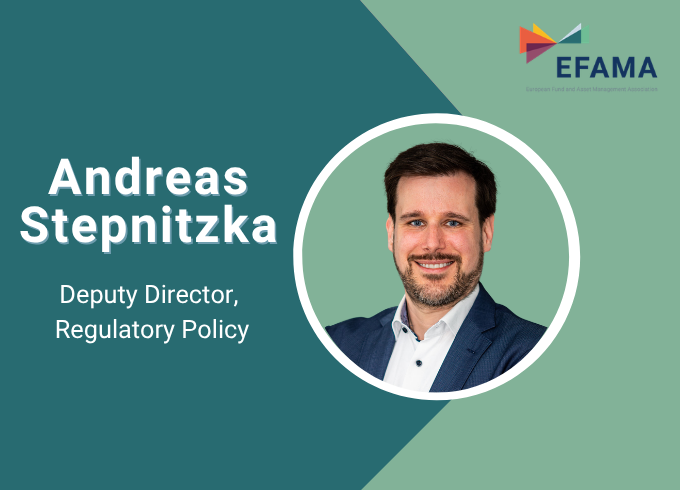
This article was published on the EFAMA blog on 27 March 2026.
By Andreas Stepnitzka, Deputy Director for Regulatory Policy at EFAMA
"Simplification" and "competitiveness" are the undisputed buzzwords currently echoing through the corridors of Brussels. If you listen to political speeches and declarations, the narrative is clear: the EU rulebook has grown too unwieldy, and, to remain globally competitive, we must aggressively cut the red tape that no longer makes sense.
It is a welcome mindset. But how does this high-level rhetoric hold up on the ground?
A look at the Retail Investment Strategy (RIS) – currently being finalised between Member States and the European Parliament – provides a sobering reality check. While public statements from all sides proudly champion a simpler framework, the technical reality heading our way tells a very different story. If we look closely at two core pillars of the RIS - Value for Money (VfM) and the investor’s journey - it becomes clear that the current proposal contradicts its own fundamental objectives.
The "Value for Money" labyrinth
No one disputes the underlying principle of Value for Money (VfM). Financial products must deliver fair value to the end investor. However, translating that logical concept into hard legislation – quantifying "value" across diverse financial products and for individual clients – is where the simplification agenda hits a wall.
Take the proposed methodologies: To prove their worth under the new rules, investment funds will be forced to conduct complex peer group assessments. In contrast, insurance-based investment products, governed by the Insurance Distribution Directive (IDD), will assess VfM using a completely different set of rules based on benchmarks.
The true labyrinth emerges when these two worlds intersect. Consider what happens when a fund is sold within an insurance wrapper. How do the granular technical rules for fund peer groups interact with the overarching benchmark requirements of the insurance product? Manufacturers and distributors are left navigating a dual regime, forced to calculate, cross-reference, and justify the value of the exact same underlying investment through two, sometimes conflicting, regulatory lenses.
If this sounds like a compliance nightmare, the sheer volume of impending technical details will only exacerbate it. Take the PRIIPs Regulation as a cautionary tale. It originally set out to create a simple, comparable two-page Key Information Document (KID) for retail investors. The primary rulebook outlining the KID’s purpose is barely three pages long. Yet, the additional technical rules , detailing how to achieve this objective, run to nearly 50 pages of complex formulas and tables.
With VfM, the stakes are even higher. These incoming metrics will effectively dictate market access, deciding which products reach consumers and which are pulled from the shelves. Because so much depends on these calculations, the upcoming technical rules for both peer groups and benchmarks will inevitably be hyper-detailed. Regulators will default to "better safe than sorry," leaving the industry to navigate an even denser maze.
The investor journey and the semantics of inducements
We see a similar dynamic playing out with the investor journey. Regulating investment advice requires a delicate balance: asking the right questions to understand a client’s needs without creating a process so burdensome that it deters them from investing altogether.
Historically, the Commission has viewed the European model, where advice is often funded through inducements, with suspicion. Having failed to secure a full ban on inducements during the MiFID II negotiations, and again in the run-up to the RIS, the regulatory approach has shifted toward tightening the rules instead.
Under MiFID II, the concept of "quality enhancement" was upgraded from technical standards into the main rulebook, bringing a wave of new definitions with it. Now, history is repeating itself. The RIS proposes rebranding "quality enhancement" as "tangible benefits."
While this is being sold as a mere name change, there are good reasons to fear – based on past experience – that the Commission and ESMA will use this semantic shift as an opportunity to overhaul the existing rules on inducements. For the financial sector, this guarantees prolonged legal uncertainty and massive implementation costs to adapt to the new interpretations. When a simple terminology update threatens to trigger a wholesale rewriting of compliance frameworks, the legislation has clearly lost its way.
A necessary reset
Has simplification finally arrived in EU financial services? Looking at the RIS, the answer is a resounding “no”. Ironically, this happens at a time when market competition is already driving down fund costs organically and eroding one of the Commission’s initial arguments that investors need cheaper solutions.
In Brussels, there is often a political temptation to push a legislative file over the finish line simply because of the time invested in it. But when a framework becomes this tangled, we have to look objectively at the outcome. From calculating dual VfM metrics to navigating semantic rebrandings, one must wonder whether the massive resources required to implement these changes will generate any actual benefit for the end investor.
With the RIS, we are building a compliance machine, not an investment culture. Rather than pushing through a flawed, overly complex text and hoping to fix fundamental inconsistencies later, the most responsible policy choice is to stop. Hitting pause and initiating a strategic reset is the only logical way to deliver a framework that actually empowers European investors.
Disclaimer: these views are the author’s own and do not necessarily reflect agreed policy positions of EFAMA and its members.