EFAMA welcomes ESMA’s Consultation Paper on product governance requirements and specifically on the target market assessment and supports that the details of these requirements are laid out in the form of guidelines rather than Q&A. We agree with ESMA that drafting target market guidelines is an important aspect “for ensuring the common, uniform and consistent application” of the MIFID II product governance requirements, in particular since these rules have the potential to significantly alter the European distribution landscape.
MiFID / MiFIR
The Markets in Financial Instruments Directive (MiFID) is a cornerstone of EU financial services legislation and is of direct relevance to asset management companies. In 2014, the European Commission adopted new rules revising MiFID, consisting of a Directive (MiFID II) and a regulation (MiFIR). Overall, MiFID II yielded positive results in terms of liquidity and transparency for investors.
Among possible improvements to the MiFID framework, EFAMA encourages the creation of a well-structured, reasonably priced consolidated tape managed by ESMA and fed by all trading venues and systematic internalisers for all financial instruments. A second, long-term EFAMA objective is better enforcement of data providers’ existing obligation to provide market data on a “reasonable commercial basis”.
Related policy positions
Policy position

20 December 2016
EFAMA’s comments on ESMA’s CP on draft guidelines on MiFID II product governance requirements
Policy position
Capital Markets
Data
Distribution & Client Disclosures
05 December 2016
EFAMA's reply to ESMA's CP on RTS specifying the scope of the consolidated tape for non-equity financial instruments
EFAMA supports every efforts made to enhance financial markets regulation which reinforces the stability and the transparency of the financial system.
In that perspective, EFAMA welcomes the opportunity to comment on the ESMA Consultation Paper on RTS specifying the scope of the consolidated tape for non-equity financial instruments. We consider that a consolidate tape (“CT”) is a key positive factor for price formation and transparency.
Prior to replying to the consultation, we wish to make the following general remarks
Policy position

EMIR
21 November 2016
EFAMA response to the ESMA Discussion Paper on the trading obligation for derivatives under MiFIR
EFAMA, welcomes the opportunity to comment on the ESMA Discussion Paper (“DP”) on the trading obligation for derivatives under MiFIR.
As a principle, EFAMA supports every effort made to enhance financial market regulation which reinforces the stability of the financial system, of which MiFIR is an important part.
Prior to replying to the consultation, we wish to make the following general remarks.
Related news
Press Release

14 April 2023
European asset managers express full support for the European Parliament’s proposal on Equities Consolidated Tape (MiFIR Review)
18 European buy-side firms, including Union, Generali, Invesco, Legal and General, Schroders and Baillie Gifford, have today declared their full support for the European Parliament’s proposal on the Equities Consolidated Tape. In a letter to policymakers, they state that only an Equities/ETFs tape that delivers data in real-time and that includes pre-trade data in the form of 5 layers of best bid and offer, will meet with the necessary market demand to make the Equities/ETFs Consolidated Tape commercially viable.
Press Release

17 January 2023
MiFIDII/MiFIR review will be key to the future success and competitiveness of the EU’s capital markets
The ongoing review of MiFIDII/MiFIR is an important moment for the future success of the Capital Markets Union project. The European Council adopted their position at the end of last year and the European Parliament is currently debating these future rules, with the expectation of a draft report by the end of the month.
Policy Position

17 January 2023
MiFIDII/ MiFIR review - EFAMA-BVI-EFSA-NSA priorities
The MiFID/MiFIR review will be key to the future success and competitiveness of the EU's capital markets.
With international competition for investment heating up markedly, European legislators need to ensure that EU regulation is helping, and not hindering, capital market growth and participation.
Various European trade associations representing EU capital markets, including EFAMA, BVI, EFSA and NSA, have published a letter outlining their main priorities for the review. This includes the following core elements:
Related publications
Publication

Capital Markets
MIFID
16 November 2021
Buy-side use-cases for a real-time consolidated tape
A real-time consolidated tape, provided it is made available at a reasonable cost, will bring many benefits to European capital markets. A complete and consistent view of market-wide prices and trading volumes is necessary for any market, though this is especially true for the EU where trading is fragmented across a large number of trading venues. A real-time consolidated tape should cover equities and bonds, delivering data in ‘as close to real-time as technically possible’ after receipt of the data from the different trade venues.
Infographic
Capital Markets
MIFID
Capital Markets Union
Data
06 October 2021
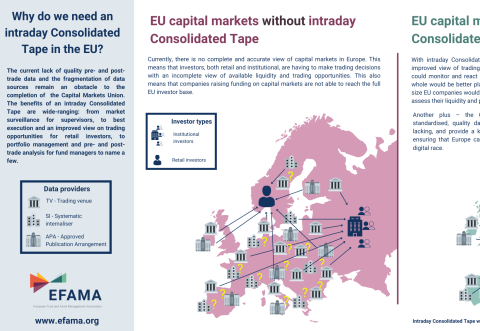
Visual | Why do we need a real-time Consolidated Tape in the EU?
The current lack of quality pre- and post-trade data and the fragmentation of data sources remain an obstacle to the completion of the Capital Markets Union. The benefits of a real-time Consolidated Tape are wide-ranging: from market surveillance for supervisors, to best execution and an improved view on trading opportunities for retail investors, to portfolio management and pre- and post-trade analysis for fund managers to name a few.
Publication

MIFID
Distribution & Client Disclosures
PRIIPs
Management Companies
AIFMD
03 June 2020
Investment Funds Distributor Due Diligence Questionnaire
Funds face unique challenges in performing intermediary oversight, and especially so because of MiFID II requirements, changing regulatory landscapes, and the absence of an industry agreed-upon standard between funds and their distribution channels. To help address these challenges, a dedicated working group developed a uniform due diligence questionnaire (DDQ) that will serve as the standard for investment funds (UCITS and AIFs) in performing onboarding and ongoing oversight of distribution channels.