Investors, originators issuers and other market participants represented by the above signatories are committed to supporting a safe and sustainable securitisation market that serves the real economy in Europe.
Investment managers, acting on behalf of their retail and institutional clients, are among the largest investors in financial markets. They represent a key component of the market’s “buy-side” segment.
In representing the interests of its members on wholesale capital market issues, EFAMA advocates for fair, deep, liquid, and transparent capital markets, supported by properly regulated and supervised market infrastructure.

Investors, originators issuers and other market participants represented by the above signatories are committed to supporting a safe and sustainable securitisation market that serves the real economy in Europe.
EFAMA is grateful for the opportunity to contribute to the drafting of the Regulation through a consultation and we appreciate the effort of the regulator to adopt an approach to reporting consistent with EMIR and to develop, where more efficient, a different reporting logic.
The signatories share the following views:
• Securitisation is an important element of well-functioning financial markets. Prudently deployed and sensibly regulated, it can:
o act as a bridge between the banks’ financing and the capital markets;
o enable non-banks to diversify funding sources; and
o provide investors with high quality fixed income securities at attractive yields.
The European Fund and Asset Management Association (EFAMA) has today published its position paper on the European Commission’s proposed Markets in Financial Instruments Regulation review which establishes a blueprint for a consolidated tape (CT) across Europe’s capital markets.


The Joint Associations1 welcome clarification from ESMA that national competent authorities are expected not to prioritise supervisory actions in relation to the application of the CSDR buy-in regime.2

A real-time consolidated tape, provided it is made available at a reasonable cost, will bring many benefits to European capital markets. A complete and consistent view of market-wide prices and trading volumes is necessary for any market, though this is especially true for the EU where trading is fragmented across a large number of trading venues. A real-time consolidated tape should cover equities and bonds, delivering data in ‘as close to real-time as technically possible’ after receipt of the data from the different trade venues.
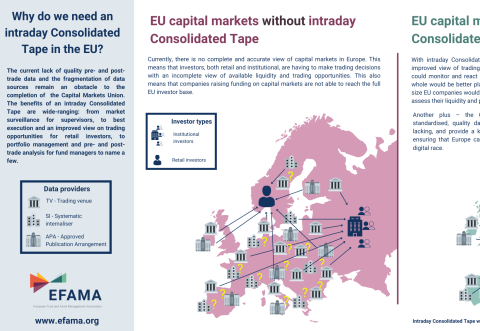
The current lack of quality pre- and post-trade data and the fragmentation of data sources remain an obstacle to the completion of the Capital Markets Union. The benefits of a real-time Consolidated Tape are wide-ranging: from market surveillance for supervisors, to best execution and an improved view on trading opportunities for retail investors, to portfolio management and pre- and post-trade analysis for fund managers to name a few.