Data
In the modern economy, data is increasingly becoming a strategic asset. This is particularly true for the asset management industry, where data forms the backbone of the daily activities and internal processes necessary to guarantee best practices in portfolio management.
Asset managers are major users of a variety of data, including market data, index data and, increasingly, ESG data. EFAMA advocates for, and seeks to support members’ access to, high-quality, standardised and comparable data at a fair price. EFAMA also encourages the creation of a well-structured, reasonably priced consolidated tape fed by all trading venues and systematic internalisers for all financial instruments.
EFAMA’s response to ESMA’s CP on data costs and consolidated tape
EFAMA's reply to ESMA's CP on RTS specifying the scope of the consolidated tape for non-equity financial instruments
EFAMA supports every efforts made to enhance financial markets regulation which reinforces the stability and the transparency of the financial system.
In that perspective, EFAMA welcomes the opportunity to comment on the ESMA Consultation Paper on RTS specifying the scope of the consolidated tape for non-equity financial instruments. We consider that a consolidate tape (“CT”) is a key positive factor for price formation and transparency.
Prior to replying to the consultation, we wish to make the following general remarks

The European Single Access Point: a powerful tool for investors to assess the ESG performance of companies
EFAMA sees the European Commission’s proposal for the creation of a European Single Access Point (ESAP) as a crucial step in addressing the limited availability and scattered nature of financial and sustainability-related entity information at EU level.

Statement on the release of the Oliver Wyman study ‘Caught on Tape’
“Oliver Wyman’s study ‘Caught on Tape’ provides a perplexing take on Consolidated Tape for Europe. Sure enough, it starts with accurate observations: the high number of trading venues in Europe, the resultant fragmented liquidity, unseen liquidity due to the lack of a consolidated tape, and the fact that leading markets like the US and Canada today benefit from a real time consolidated tape.
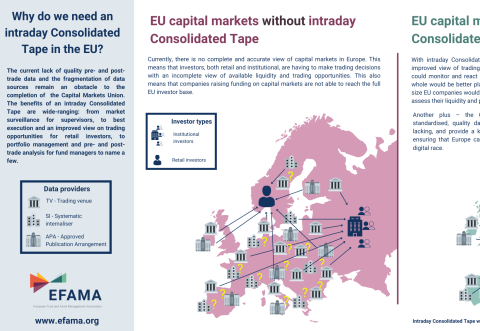
Visual | Why do we need a real-time Consolidated Tape in the EU?
The current lack of quality pre- and post-trade data and the fragmentation of data sources remain an obstacle to the completion of the Capital Markets Union. The benefits of a real-time Consolidated Tape are wide-ranging: from market surveillance for supervisors, to best execution and an improved view on trading opportunities for retail investors, to portfolio management and pre- and post-trade analysis for fund managers to name a few.

Annual Review June 2019-June 2020
"It gives me great pleasure to provide you with an overview of our activities since our Annual General Meeting in Paris last year. While we were very much looking forward to hosting you all in Brussels this week, the current crisis and associated travel restrictions has forced us to improvise and turn our meeting into a virtual AGM.

EFAMA Market Insights | Issue #1 | Net outflows from UCITS in March 2020 - Industry weathers Covid-19 crisis
The Covid-19 pandemic significantly impacted financial markets. Stock markets across the world suffered a steep decline driven by lower economic growth and corporate profits. As anticipated, the crisis caused substantial net outflows from UCITS in March (EUR 313 billion). However, as a percentage of net assets, these outflows were no higher than in October 2008, at the height of the global financial crisis (2.9%).

3 Questions to Rudolf Siebel on Market Data Costs
Q #1 Have you witnessed an increase in the cost of market data over the last couple of years? If so, how can it be explained?