EFAMA welcomes ESMA’s Call for Evidence on asset segregation and custody services as a precious occasion to confirm our previous key messages - as per our response to the previous consultation around Guidelines on asset segregation under the AIFMD of December 2014 – and to clarify our position on new aspects of ESMA’s work.
UCITS
UCITS (Undertakings for Collective Investment in Transferable Securities) refers to the EU framework for harmonising the creation, management and marketing of collective investment schemes in the EU (and EEA) Member States. It places a strong focus on investors’ protection and product regulation. Owing to this harmonised framework, once UCITS funds are registered in one Member State, they can be freely marketed across the European Union. Initially adopted in 1985, the UCITS Directive has since been modified repeatedly, to take into account developments in financial markets.
EFAMA is adamant to protect the competitiveness and international appeal of UCITS.
Related policy positions
Policy position

EU Fund regulation
UCITS
Management Companies
AIFMD
23 September 2016
EFAMA response to ESMA Call for Evidence on asset segregation
Policy position
Capital Markets Union
Distribution & Client Disclosures
PRIIPs
EU Fund regulation
ELTIF
UCITS
Management Companies
AIFMD
21 March 2016
EFAMA response to Green Paper on Retail Financial Services
EFAMA welcomes the opportunity to respond to the European Commission’s Green Paper on retail financial services. Widening the opportunities for European citizens to save and invest will facilitate better outcomes both for savers and the wider European economy.
EFAMA fully shares the goals of a Single Market for retail financial services in the EU, i.e.:
1. Promoting an EU-wide market in retail financial services that can facilitate cross-border business and consumer choice.
Policy position
EU Fund regulation
UCITS
Management Companies
AIFMD
22 January 2016
EFAMA response to EC consultation on impacts of maximum remuneration ratio under CRD IV
Our corporate members are both subsidiaries of an EEA parent that is a credit institution as per Article 4(1)(1) of the CRR, or stand-alone investment firms as per Article 4(1)(2) of the CRR. Both types of entities risk becoming subject to the Maximum Ratio Rule as asset management companies licensed under either a UCITS or AIFM management company license, or licensed as investment firms under the MiFID regime to provide discretionary portfolio management services on a client-by-client basis.
Related news
Press Release

Exchange-traded Funds
UCITS
Statistics
28 November 2025
ETF inflows on track for new record in 2025
Today, EFAMA has published its latest Monthly Statistical Release for September 2025.
Press Release

UCITS
Statistics
24 October 2025
Strong net inflows into long-term UCITS continue in August
Today, EFAMA has published its latest Monthly Statistical Release for August 2025.
Viewpoint

UCITS
24 June 2025
Net Returns and Fund Costs: A Nuanced Look at Value in UCITS
This article was published in the 23rd edition of the Fact Book on 24 June 2025.
Given the emphasis on costs and value for money for European investors, we have examined whether lower fees consistently translate into better net performance. Our analysis shows that this is not always the case; less-expensive funds do not necessarily deliver the highest returns, and in some instances, higher-cost funds outperform.
Related publications
Publication
EU Fund regulation
UCITS
04 March 2022
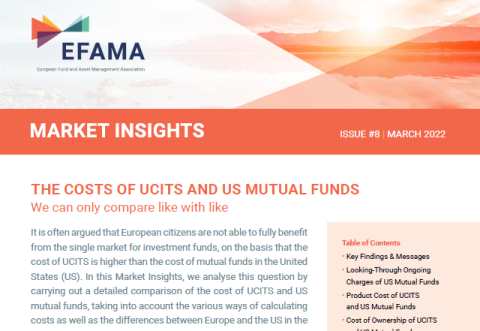
The costs of UCITS and US mutual funds | Market Insights | Issue #8
It is often argued that European citizens are not able to fully benefit from the single market for investment funds, on the basis that the cost of UCITS is higher than the cost of mutual funds in the United States (US). In this Market Insights, we analyse this question by carrying out a detailed comparison of the cost of UCITS and US mutual funds, taking into account the various ways of calculating costs as well as the differences between Europe and the US in the way investment funds are distributed.
Publication

EU Fund regulation
UCITS
Statistics
16 September 2021
Fund managers retain only 41% of the total cost paid by retail investors | Market Insights | Issue #6
EFAMA has released its latest Market Insights report titled “Perspective on the costs of UCITS”. The full report breaks down the costs of UCITS, focusing on the fees charged for the different services provided along the investment fund value chain and distinguishing between the product cost for which fund managers are directly responsible, and the
Publication

Capital Markets Union
UCITS
20 July 2021
Market Insights | Issue #5 | Perspective on the net performance of UCITS
Equity UCITS delivered a total net return of 108% in real terms in 2010-2019, whereas bank deposits lost 10% in net value


Contact

Deputy Director, Regulatory Policy