


EFAMA has today published its latest monthly Investment Fund Industry Fact Sheet, which provides net sales data on UCITS and AIFs for October 2022, at European level and by country of fund domiciliation.




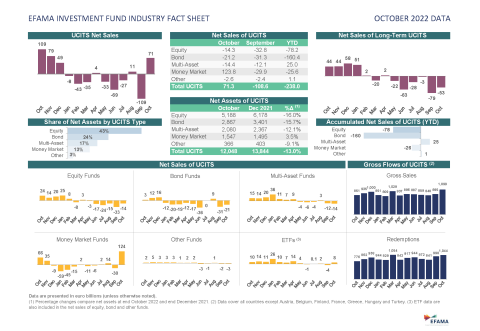
EFAMA has today published its latest monthly Investment Fund Industry Fact Sheet, which provides net sales data on UCITS and AIFs for October 2022, at European level and by country of fund domiciliation.

EFAMA commends the efforts of the Czech Presidency and Member States in reaching an agreement on the review of MiFIR/MiFID. EFAMA members welcome the Council position which unequivocally comes down on the side of competitive, globally attractive markets, driven by diversity and innovation and the right tools and infrastructures to support the retail investor.

EFAMA, together with EBF, Insurance Europe, EACB, EAPB, ESBG and EUSIPA, issued a public letter addressed to Vice-President Dombrovskis, Commissioners McGuinness and Director-General Berrigan, remarking the importance of advice for European retail investors and the need to maintain the coexistence of fee-based and commission-based advice.
EFAMA has today published its International Quarterly Statistical Release regarding the developments in the worldwide investment fund industry during the third quarter of 2022.
EFAMA's latest edition of its 'Asset Management in Europe' report provides an in-depth analysis of recent trends, focusing on where investments funds and discretionary mandates are managed in Europe.
The asset management sector is a crucial one for the European economy, with a key role to play in financing the green transition:

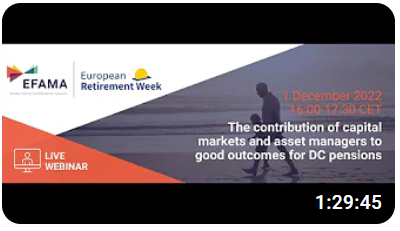
The European Retirement Week 2022 took place from 28 November to 3 December 2022.

EFAMA has today published its European Quarterly Statistical Release for Q3 of 2022.
This Release presents for the first time data on the net sales and net assets of SFDR Article 8 and 9 UCITS.

EFAMA members are paying close attention to the ongoing discussions in the European Parliament and Council to reach a compromise on the MiFID review. Together with a broad majority of market participants, including the sell-side and alternative trading venues, we have consistently made the case for a real-time tape for equities with the inclusion of pre and post-trade data.





EFAMA welcomes the FSB recommendation that jurisdictions develop domestic frameworks to monitor and mitigate the build-up of leverage. These analytical frameworks should take a holistic approach and be empirically driven. The main systemic risk stemming from leverage is the imbalance between liquidity demand and supply during periods of stress, not the (collective) default of non-bank financial intermediaries.

In its response to IOSCO’s consultation on the revised recommendations for liquidity risk management for collective investment schemes, EFAMA welcomes the fact that IOSCO recognises aspects essential for proper risk management (e.g., asset managers’ primary responsibility and the absence of one-size-fits-all approaches).

EFAMA has submitted its response to ESMA’s consultation on the Active Account Requirements (AAR). Our industry stands ready to implement the AAR by June 2025... However, we have strong reservations about the heavy and redundant reporting requirements.

In its response to the Commission’s consultation on assessing the adequacy of macroprudential policies for NBFI, EFAMA stresses that Europe needs more holistic and rigorous analyses to determine where financial stability risks lie. Unfortunately, even though investment funds have proven resilient in recent years despite frequent market disruptions, the consultation focuses on the asset management industry.
Discover the 6 reasons why your organisation should become a member of EFAMA.
Our members enjoy significant benefits including the opportunity to shape the industry positions, get first-hand access to regulatory and political intelligence, engage with industry peers and policymakers, and take part in EFAMA events.
Our three membership categories cater to the wide range of organisations that make up and support the investment management industry in Europe.