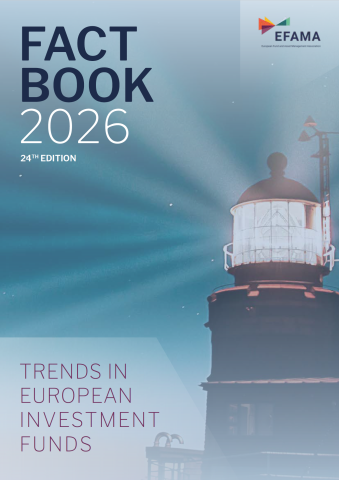



EFAMA has today published its European Quarterly Statistical Release for Q1 of 2023.





EFAMA has today published its European Quarterly Statistical Release for Q1 of 2023.

On 24 May 2023, the European Commission unveiled the most extensive reform of the EU legislative framework for retail investment to-date. As representatives of the European financial and insurance sector, we (AMICE, EACB, EAPB, EBF, EFAMA, ESBG, EUSIPA, Insurance Europe) are still assessing the full range of impacts and changes put forward in the Retail Investment Strategy (RIS) across multiple pieces of regulation: MiFID II, the Insurance Distribution Directive, the UCITS Directive, the Alternative Investment Fund Managers Directive, the PRIIPs Regulation and the Solvency II Directive.
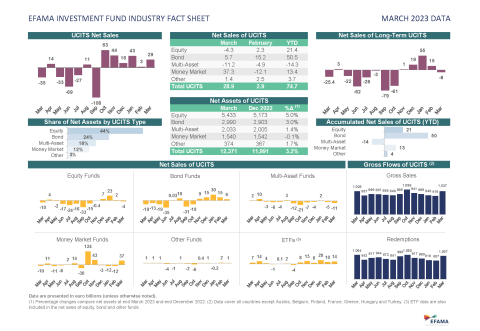
EFAMA has today published its latest monthly Investment Fund Industry Fact Sheet, which provides net sales data on UCITS and AIFs for March 2023, at European level and by country of fund domiciliation.

EFAMA believes that IORPs should be able to invest in financial instruments traded in all third country markets where the latter meet certain conditions, regardless of the adoption of an equivalence decision by the Commission (...).

The publication of the European Commission’s long-awaited EU Retail Investment Strategy is an important moment, as creating the necessary conditions to grow retail investor participation in capital markets is key for the future of both the European economy and EU citizens. Within the strategy, we see positive elements which the fund industry has long encouraged, such as digital-by-default disclosures, the preservation of both fee- and commission-based distribution models, and comparable rules for all types of investment products.

European asset managers continue to urge policymakers to support the European Parliament’s proposal for an Equities/ETFs consolidated tape which includes 5 layers of real-time pre-trade data. Market participants, including the European buy and sell-sides have consistently maintained that a post-trade only equities/ETFs consolidated tape will not meet with the market demand required to make the tape commercially viable. Tanguy van de Werve, Director General of EFAMA, stated: “This would be a legislative se

In our response to ESMA on its review of the guidelines on stress-testing parameters for Money Market Funds (MMFs), EFAMA cautions against using overly simplistic assumptions.

EFAMA has today published its latest monthly Investment Fund Industry Fact Sheet, which provides net sales data on UCITS and AIFs for February 2023, at European level and by country of fund domiciliation.



EFAMA responded to one particular section of the Green Paper on Ageing published by the European Commission.
Members of the Pension Standing Committee addressed the following questions: What role could supplementary pensions play in ensuring adequate retirement incomes? How could they be extended throughout the EU and what would be the EU’s role in this process?
They recommend actions in four specific areas:

EFAMA welcomes the proposed revised OECD Roadmap. We would like to congratulate the OECD team working on private pensions for the wide-ranging research projects it undertook over the past years, which provided sound, evidence-based arguments to update the 2012 Roadmap.
We strongly support the main messages of the Roadmap, in particular the importance of

The Commission launched a public consultation ahead of the presentation of a legislative proposal to introduce an EU Digital Levy by January 2023. For EFAMA, any new tax legislation on “digital activities” (or “digital transactions”) should not be borne by the end-investors. Our understanding is that the industry’s activities should not be in scope of the new tax.

EFAMA shares the urgent need to improve the consistency and comparability of sustainability reporting at a global level. We believe this is a crucial enabling factor to the success of the global efforts to mainstream sustainability in the financial sector. A global set of internationally recognised sustainability reporting standards would help establish an effective chain of information from corporates to the benefit of investors.

On 11 March 2021, EFAMA and 14 trade associations representing a wide range of stakeholders in the European and global financial markets wrote to the European Commission and ESMA raising concerns about the implementation of the mandatory buy-in requirement under the EU’s CSDR Settlement Discipline Regime.

EFAMA supports the European Commission's initiative to establish the European Single Access Point. We see it as a unique opportunity for the Capital Markets Union to centralise all publicly available ESG and financial transparency information data in one place.

Discover the 6 reasons why your organisation should become a member of EFAMA.
Our members enjoy significant benefits including the opportunity to shape the industry positions, get first-hand access to regulatory and political intelligence, engage with industry peers and policymakers, and take part in EFAMA events.
Our three membership categories cater to the wide range of organisations that make up and support the investment management industry in Europe.