


EFAMA has today published its European Quarterly Statistical Release for Q1 of 2023.






EFAMA has today published its European Quarterly Statistical Release for Q1 of 2023.

On 24 May 2023, the European Commission unveiled the most extensive reform of the EU legislative framework for retail investment to-date. As representatives of the European financial and insurance sector, we (AMICE, EACB, EAPB, EBF, EFAMA, ESBG, EUSIPA, Insurance Europe) are still assessing the full range of impacts and changes put forward in the Retail Investment Strategy (RIS) across multiple pieces of regulation: MiFID II, the Insurance Distribution Directive, the UCITS Directive, the Alternative Investment Fund Managers Directive, the PRIIPs Regulation and the Solvency II Directive.
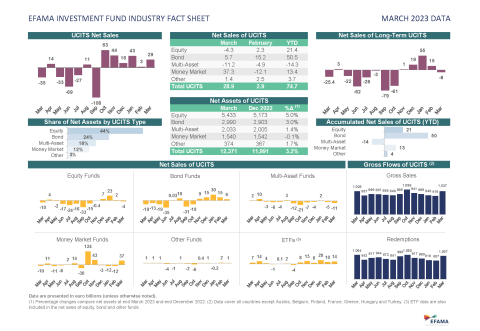
EFAMA has today published its latest monthly Investment Fund Industry Fact Sheet, which provides net sales data on UCITS and AIFs for March 2023, at European level and by country of fund domiciliation.

EFAMA believes that IORPs should be able to invest in financial instruments traded in all third country markets where the latter meet certain conditions, regardless of the adoption of an equivalence decision by the Commission (...).

The publication of the European Commission’s long-awaited EU Retail Investment Strategy is an important moment, as creating the necessary conditions to grow retail investor participation in capital markets is key for the future of both the European economy and EU citizens. Within the strategy, we see positive elements which the fund industry has long encouraged, such as digital-by-default disclosures, the preservation of both fee- and commission-based distribution models, and comparable rules for all types of investment products.

European asset managers continue to urge policymakers to support the European Parliament’s proposal for an Equities/ETFs consolidated tape which includes 5 layers of real-time pre-trade data. Market participants, including the European buy and sell-sides have consistently maintained that a post-trade only equities/ETFs consolidated tape will not meet with the market demand required to make the tape commercially viable. Tanguy van de Werve, Director General of EFAMA, stated: “This would be a legislative se

In our response to ESMA on its review of the guidelines on stress-testing parameters for Money Market Funds (MMFs), EFAMA cautions against using overly simplistic assumptions.

EFAMA has today published its latest monthly Investment Fund Industry Fact Sheet, which provides net sales data on UCITS and AIFs for February 2023, at European level and by country of fund domiciliation.



The European Fund and Asset Management Association (EFAMA) calls on the European Commission to reflect EFRAG´s recommendations for mandatory European Sustainability Reporting Standards in the upcoming NFRD review.

As the European trade association representing numerous ETF issuers, EFAMA welcomes the opportunity of this questionnaire to submit a few high-level considerations to the attention of Committee 5 member supervisors. Our inputs are intended to accompany the more detailed submissions of the several European ETF issuers our association represents, in view of informing the Committee’s future work around a possible review of IOSCO’s 2013 Principles for the Regulation of Exchange Traded Funds.

EFAMA supports the initiatives launched by IOSCO and other regulators (e.g. ESMA, FCA, SEC) to analyse and address the significant issues concerning market data in the secondary equity market.

Investors would benefit from an EU legal framework with due diligence guidelines and reporting requirements for companies in the real economy. This framework should be consistent with the reporting requirements in the revised NFRD and the disclosures in the Sustainability-Related Disclosures regulation (SFDR). At the same time, any framework for supply chain due diligence should not impose a competitive disadvantage for EU companies.

EFAMA believes that ESMA’s draft ‘marketing communication’ Guidelines still require important clarifications to ensure full alignment between them and MiFID II’s Commission Delegated Regulation Article 44. This alignment is essential to ensure coherent rules for fund management companies and distributors. Unfortunately, parts of the proposed Guidelines are overly prescriptive and may unintentionally make some marketing materials vaguer or even inconsistent with local MiFID requirements for distributors.

A flawed review process not tackling the heart of the issue
EFAMA has always made it clear that a revision of the PRIIPs Regulatory Technical Standard (RTS) falls short of conducting a proper Level 1 review. A review that is explicitly required by the Level 1 Regulation and is overdue for more than one year.

Discover the 6 reasons why your organisation should become a member of EFAMA.
Our members enjoy significant benefits including the opportunity to shape the industry positions, get first-hand access to regulatory and political intelligence, engage with industry peers and policymakers, and take part in EFAMA events.
Our three membership categories cater to the wide range of organisations that make up and support the investment management industry in Europe.