


The European Fund and Asset Management Association (EFAMA) has today published its latest monthly Investment Fund Industry Fact Sheet, which provides net sales data of UCITS and AIFs for June 2020.





The European Fund and Asset Management Association (EFAMA) has today published its latest monthly Investment Fund Industry Fact Sheet, which provides net sales data of UCITS and AIFs for June 2020.
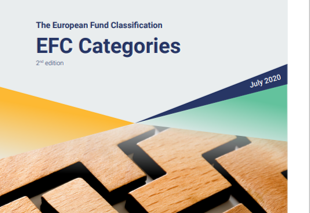
EFAMA published today the second edition of the brochure 'The European Fund Classification EFC Categories' to adapt the classification criteria to recent market evolutions. The European Fund Classification (EFC) is a pan-European classification system of investment funds, which is maintained by a Task Force of EFAMA.

For our 3rd issue, we spoke with Sheila Nicoll (Schroders) and Alexander Schindler (Union Investment), both members of the High-Level Forum on the Capital Markets Union, who kindly shared their thoughts with us on the High-Level Forum report and what it means for the asset management industry.
Report highlights developments in the European fund industry in 2019 and shines a spotlight on the growing market for cross border funds.
The European Fund and Asset Management Association (EFAMA), has published its 2020 industry Fact Book. The 2020 Fact Book provides an in-depth analysis of trends in the European fund industry as well as international level, focusing on the U.S., other advanced economies and emerging markets.

The European Fund and Asset Management Association (EFAMA), has today published its latest International Statistical Release describing the trends in worldwide investment fund industry in the first quarter of 2020*.
Worldwide regulated open-ended fund assets decreased by 10.8 percent to EUR 47.1 trillion in the first quarter of 2020. Worldwide net cash flow to all funds amounted to EUR 617 billion, compared to EUR 808 billion in the fourth quarter of 2019.

In a report released today, the International Council of Securities Associations (ICSA), the European Fund and Asset Management Association (EFAMA), and the Managed Funds Association (MFA) call for the implementation of internationally recognized principles to address excessively high market data fees and unfair licensing provisions.

The European Fund and Asset Management Association (EFAMA) has today published its Quarterly Statistical Release describing the trends in the European investment fund industry in the first quarter of 2020 with key data and indicators for each EFAMA member countries.

Funds face unique challenges in performing intermediary oversight, and especially so because of MiFID II requirements, changing regulatory landscapes, and the absence of an industry agreed-upon standard between funds and their distribution channels. To help address these challenges, a dedicated working group developed a uniform due diligence questionnaire (DDQ) that will serve as the standard for investment funds (UCITS and AIFs) in performing onboarding and ongoing oversight of distribution channels.



We commend the work that IOSCO has undertaken to date on this topic including the survey work and the summary findings in the form of the report currently under review. It is fair to say that the conclusions of the report and areas for further work gave rise to detailed discussions within our industry, yielding ultimately firm views on the priority areas that we support and see value in, and areas we felt were not reflected in the study and thereby building risk into margining models in future crisis scenarios. These areas are fur

For asset managers the main issue continues to be the reclassification of ETDs as OTCs as a result of the non-equivalence of UK regulated markets. While we understand that a review is legally mandated at this point in time, we do not see value in recalibrating the various thresholds or making changes to the calculation methodologies unless these are in the two areas we define below. Our main concern revolves around the fact that changes would carry significant compliance costs while making little impact on the population of counterparties and notional captured by the thresholds.
Investors, asset managers and civil society organisations call for the prompt implementation of the reform on corporate sustainability reporting and EU standards


This is a timely and necessary review to which we hope to contribute in a constructive manner. As already recognised in the consultation paper and in the MiFID Quick Fix proposal, RTS 27 and RTS 28 currently fall short of the objective of providing valuable and comparable datasets for investment managers and the investing public. We appreciate the present effort to revise reporting requirements to produce more meaningful reports.

The Joint Associations1 welcome clarification from ESMA that national competent authorities are expected not to prioritise supervisory actions in relation to the application of the CSDR buy-in regime.2
Discover the 6 reasons why your organisation should become a member of EFAMA.
Our members enjoy significant benefits including the opportunity to shape the industry positions, get first-hand access to regulatory and political intelligence, engage with industry peers and policymakers, and take part in EFAMA events.
Our three membership categories cater to the wide range of organisations that make up and support the investment management industry in Europe.