MiFID / MiFIR
The Markets in Financial Instruments Directive (MiFID) is a cornerstone of EU financial services legislation and is of direct relevance to asset management companies. In 2014, the European Commission adopted new rules revising MiFID, consisting of a Directive (MiFID II) and a regulation (MiFIR). Overall, MiFID II yielded positive results in terms of liquidity and transparency for investors.
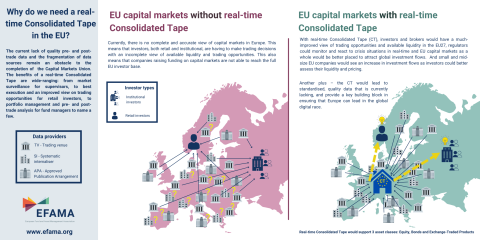
Among possible improvements to the MiFID framework, EFAMA encourages the creation of a well-structured, reasonably priced consolidated tape managed by ESMA and fed by all trading venues and systematic internalisers for all financial instruments. A second, long-term EFAMA objective is better enforcement of data providers’ existing obligation to provide market data on a “reasonable commercial basis”.

Joint letter on open Access and Interoperability in Cash Equities Clearing

EFAMA response to ESMA’s call for evidence on the Structure of European Equity Markets

Latest Parliament report takes the Market Integration and Supervision Package in the wrong direction
Turning ESMA into an extra supervisor for asset managers is unwarranted, a major distraction, and runs contrary to the EU competitiveness and simplification agendas

European asset managers express full support for the European Parliament’s proposal on Equities Consolidated Tape (MiFIR Review)
18 European buy-side firms, including Union, Generali, Invesco, Legal and General, Schroders and Baillie Gifford, have today declared their full support for the European Parliament’s proposal on the Equities Consolidated Tape. In a letter to policymakers, they state that only an Equities/ETFs tape that delivers data in real-time and that includes pre-trade data in the form of 5 layers of best bid and offer, will meet with the necessary market demand to make the Equities/ETFs Consolidated Tape commercially viable.

MiFIDII/MiFIR review will be key to the future success and competitiveness of the EU’s capital markets
The ongoing review of MiFIDII/MiFIR is an important moment for the future success of the Capital Markets Union project. The European Council adopted their position at the end of last year and the European Parliament is currently debating these future rules, with the expectation of a draft report by the end of the month.

MiFIDII/ MiFIR review - EFAMA-BVI-EFSA-NSA priorities
The MiFID/MiFIR review will be key to the future success and competitiveness of the EU's capital markets.
With international competition for investment heating up markedly, European legislators need to ensure that EU regulation is helping, and not hindering, capital market growth and participation.
Various European trade associations representing EU capital markets, including EFAMA, BVI, EFSA and NSA, have published a letter outlining their main priorities for the review. This includes the following core elements:

3 Questions to Rudolf Siebel on Market Data Costs
Q #1 Have you witnessed an increase in the cost of market data over the last couple of years? If so, how can it be explained?