Capital markets
Investment managers, acting on behalf of their retail and institutional clients, are among the largest investors in financial markets. They represent a key component of the market’s “buy-side” segment.
In representing the interests of its members on wholesale capital market issues, EFAMA advocates for fair, deep, liquid, and transparent capital markets, supported by properly regulated and supervised market infrastructure.
EFAMA's response to the EU Commission's consultation on the review of the MiFID II / MiFIR Regulatory Framework
EFAMA reply to ECB's Flash survey on operation of Post Trade Servides during the Covid-19 pandemic
Industry Association Letter on Impact of COVID-19 on Initial Margin Phase-In
Households continue to keep a disproportionate amount of money in bank deposits in most European countries
New report calls for action to be taken to revive the Capital Markets Union project
Household Participation in Capital Markets
This report analyses the progress made in recent years by European households in allocating more of their financial wealth to capital market instruments (pension plans, life insurance, investment funds, debt securities and listed shares) and less in cash and bank deposits. It also includes policy recommendations on improving retail participation in capital markets, including for the Retail Investment Strategy currently under discussion.

Some key findings include:
Buy-side experts worried that mandatory active accounts for EU clearing could increase systemic risks, not lower them
EFAMA is pleased to share the link to the educational webinar it organised on 14 June with leading buy-side clearing experts, including Allianz Global Investors, Aviva Investors, BlackRock and Nordea Asset Management, to discuss the main findings of EFAMA's recent analysis on mandated active accounts for EU clearing.
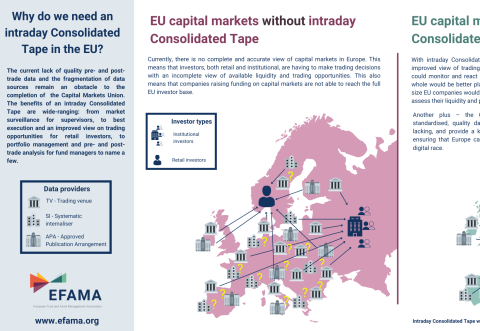
Visual | Why do we need a real-time Consolidated Tape in the EU?
The current lack of quality pre- and post-trade data and the fragmentation of data sources remain an obstacle to the completion of the Capital Markets Union. The benefits of a real-time Consolidated Tape are wide-ranging: from market surveillance for supervisors, to best execution and an improved view on trading opportunities for retail investors, to portfolio management and pre- and post-trade analysis for fund managers to name a few.
3 Questions to Jean-Louis Schirmann on the use of EURIBOR
Q #1 How was Euribor impacted by the adoption of the Benchmark Regulation (BMR) and what are the relevant features of the reformed Euribor for investment managers?

3 Questions to Christophe Binet on LIBOR Transition
Q #1 When will LIBOR phase out and which rates will be replacing it?
The London Interbank Offered Rate, also known as LIBOR®, is a widely-used index for short-term interest rates that is commonly found in