EFAMA welcomes ESMA’s Consultation Paper on product governance requirements and specifically on the target market assessment and supports that the details of these requirements are laid out in the form of guidelines rather than Q&A. We agree with ESMA that drafting target market guidelines is an important aspect “for ensuring the common, uniform and consistent application” of the MIFID II product governance requirements, in particular since these rules have the potential to significantly alter the European distribution landscape.
MiFID / MiFIR
The Markets in Financial Instruments Directive (MiFID) is a cornerstone of EU financial services legislation and is of direct relevance to asset management companies. In 2014, the European Commission adopted new rules revising MiFID, consisting of a Directive (MiFID II) and a regulation (MiFIR). Overall, MiFID II yielded positive results in terms of liquidity and transparency for investors.
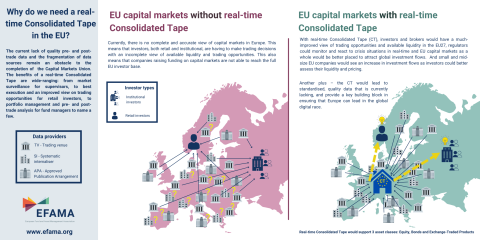
Among possible improvements to the MiFID framework, EFAMA encourages the creation of a well-structured, reasonably priced consolidated tape managed by ESMA and fed by all trading venues and systematic internalisers for all financial instruments. A second, long-term EFAMA objective is better enforcement of data providers’ existing obligation to provide market data on a “reasonable commercial basis”.
Related policy positions
Policy position

20 December 2016
EFAMA’s comments on ESMA’s CP on draft guidelines on MiFID II product governance requirements
Policy position
Capital Markets
Data
Distribution & Client Disclosures
05 December 2016
EFAMA's reply to ESMA's CP on RTS specifying the scope of the consolidated tape for non-equity financial instruments
EFAMA supports every efforts made to enhance financial markets regulation which reinforces the stability and the transparency of the financial system.
In that perspective, EFAMA welcomes the opportunity to comment on the ESMA Consultation Paper on RTS specifying the scope of the consolidated tape for non-equity financial instruments. We consider that a consolidate tape (“CT”) is a key positive factor for price formation and transparency.
Prior to replying to the consultation, we wish to make the following general remarks
Policy position

EMIR
21 November 2016
EFAMA response to the ESMA Discussion Paper on the trading obligation for derivatives under MiFIR
EFAMA, welcomes the opportunity to comment on the ESMA Discussion Paper (“DP”) on the trading obligation for derivatives under MiFIR.
As a principle, EFAMA supports every effort made to enhance financial market regulation which reinforces the stability of the financial system, of which MiFIR is an important part.
Prior to replying to the consultation, we wish to make the following general remarks.
Related news
Policy Position

Capital Markets
07 July 2026
Joint letter on open Access and Interoperability in Cash Equities Clearing
Policy Position

Capital Markets
MIFID
Capital Markets Union
01 July 2026
EFAMA response to ESMA’s call for evidence on the Structure of European Equity Markets
Press Release

Capital Markets
EMIR
MIFID
Capital Markets Union
EU Fund regulation
Supervision
18 June 2026
Latest Parliament report takes the Market Integration and Supervision Package in the wrong direction
Turning ESMA into an extra supervisor for asset managers is unwarranted, a major distraction, and runs contrary to the EU competitiveness and simplification agendas
Related publications
Publication

Capital Markets
MIFID
Data
Distribution & Client Disclosures
04 March 2020
3 Questions to Rudolf Siebel on Market Data Costs
Q #1 Have you witnessed an increase in the cost of market data over the last couple of years? If so, how can it be explained?
Past events


Members Only
EFAMA & AFME
Navigating the MiFIR Review: (Part 2) Consolidated Tape & Market Data
Virtual