EFAMA welcomes ESMA’s Consultation Paper on product governance requirements and specifically on the target market assessment and supports that the details of these requirements are laid out in the form of guidelines rather than Q&A. We agree with ESMA that drafting target market guidelines is an important aspect “for ensuring the common, uniform and consistent application” of the MIFID II product governance requirements, in particular since these rules have the potential to significantly alter the European distribution landscape.
MiFID / MiFIR
The Markets in Financial Instruments Directive (MiFID) is a cornerstone of EU financial services legislation and is of direct relevance to asset management companies. In 2014, the European Commission adopted new rules revising MiFID, consisting of a Directive (MiFID II) and a regulation (MiFIR). Overall, MiFID II yielded positive results in terms of liquidity and transparency for investors.
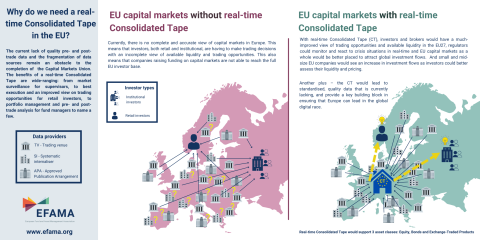
Among possible improvements to the MiFID framework, EFAMA encourages the creation of a well-structured, reasonably priced consolidated tape managed by ESMA and fed by all trading venues and systematic internalisers for all financial instruments. A second, long-term EFAMA objective is better enforcement of data providers’ existing obligation to provide market data on a “reasonable commercial basis”.
Related policy positions
Policy position

20 December 2016
EFAMA’s comments on ESMA’s CP on draft guidelines on MiFID II product governance requirements
Policy position
Capital Markets
Data
Distribution & Client Disclosures
05 December 2016
EFAMA's reply to ESMA's CP on RTS specifying the scope of the consolidated tape for non-equity financial instruments
EFAMA supports every efforts made to enhance financial markets regulation which reinforces the stability and the transparency of the financial system.
In that perspective, EFAMA welcomes the opportunity to comment on the ESMA Consultation Paper on RTS specifying the scope of the consolidated tape for non-equity financial instruments. We consider that a consolidate tape (“CT”) is a key positive factor for price formation and transparency.
Prior to replying to the consultation, we wish to make the following general remarks
Policy position

EMIR
21 November 2016
EFAMA response to the ESMA Discussion Paper on the trading obligation for derivatives under MiFIR
EFAMA, welcomes the opportunity to comment on the ESMA Discussion Paper (“DP”) on the trading obligation for derivatives under MiFIR.
As a principle, EFAMA supports every effort made to enhance financial market regulation which reinforces the stability of the financial system, of which MiFIR is an important part.
Prior to replying to the consultation, we wish to make the following general remarks.
Related news
Press Release

29 November 2022
The availability of a real-time consolidated tape in Europe is critical for the success of the CMU
EFAMA members are paying close attention to the ongoing discussions in the European Parliament and Council to reach a compromise on the MiFID review. Together with a broad majority of market participants, including the sell-side and alternative trading venues, we have consistently made the case for a real-time tape for equities with the inclusion of pre and post-trade data.
Policy Position

11 July 2022
EFAMA responses to the discussion questions within the IOSCO report “corporate bond markets – drivers of liquidity during covid-19 induced market stresses”
EFAMA is appreciative of the opportunity to comment on this major IOSCO study on the dynamics of bond market liquidity during market stresses. We provide some detailed responses below, but would reiterate a few high-level points here:
Press Release

Capital Markets
MIFID
16 February 2022
EFAMA – the urgency behind a consolidated tape for Europe | A buy-side view on consolidated tape and market structure reforms
The European Fund and Asset Management Association (EFAMA) has today published its position paper on the European Commission’s proposed Markets in Financial Instruments Regulation review which establishes a blueprint for a consolidated tape (CT) across Europe’s capital markets.
Related publications
Publication

Capital Markets
MIFID
Data
Distribution & Client Disclosures
04 March 2020
3 Questions to Rudolf Siebel on Market Data Costs
Q #1 Have you witnessed an increase in the cost of market data over the last couple of years? If so, how can it be explained?