EFAMA supports the initiatives launched by IOSCO and other regulators (e.g. ESMA, FCA, SEC) to analyse and address the significant issues concerning market data in the secondary equity market.
MiFID
The Markets in Financial Instruments Directive governs how funds (and other financial instruments) can be sold and distributed to investors throughout the EU. It does this by balancing investor protection (governing under what rules and conditions investment advice and portfolio management can be given) with providing the right amount of information about products and services (information about the products’ objectives and costs). In most cases, this type of financial advice, which connects funds with end investors, is provided not by fund managers, but by other financial players, such as banks or financial advisers.
Against this backdrop, EFAMA wants to ensure that these rules are balanced and the information provided to investors is meaningful. While more protection is necessary for retail investors, MiFID should allow other, more professional investors, more freedom in defining what information is necessary to conduct their day-to-day business. Also, MiFID must not make it impossible for ordinary EU citizens to access financial advice to save for their future and retirement.

EFAMA responds to IOSCO Consultation on Market Data in Secondary Equity Market
EFAMA reply to ESMA CP on marketing communications guidelines
EFAMA believes that ESMA’s draft ‘marketing communication’ Guidelines still require important clarifications to ensure full alignment between them and MiFID II’s Commission Delegated Regulation Article 44. This alignment is essential to ensure coherent rules for fund management companies and distributors. Unfortunately, parts of the proposed Guidelines are overly prescriptive and may unintentionally make some marketing materials vaguer or even inconsistent with local MiFID requirements for distributors.
EFAMA's reply to ESMA's CP on the Guidelines on the MiFID II / MiFIR Obligations on Market Data
EFAMA welcomes this ESMA initiative and we agree with the conclusions in the ESMA Report that there is an overall need to strengthen the laws applicable to data in connection with the MiFIDII/MiFIR Review, aside the implementation of a Consolidated Tape . We consider that the draft Guidelines will further strengthen the MiFID level 1 and level 2 measures and will foster the establishment of a cost-based approach for market data procurement. Therefore, we would be in favour of turning the proposed guidelines into binding regulation.


Joint trade associations urge policymakers not to concede to suboptimal outcomes in MiFIR review
EU asset managers, banks and brokers are today urging policy makers not to concede to pressure which will lead to suboptimal outcomes in the review of the Markets in Financial Instruments Directive (MiFID/R).

European asset managers in full support of the European Parliament's proposal on Equities Consolidated Tape
In a letter to policymakers, 18 European buy-side firms state that only an Equities/ETFs tape that delivers data in real-time and that includes pre-trade data in the form of 5 layers of best bid and offer, will meet with the necessary market demand to make the Equities/ETFs Consolidated Tape commercially viable. A reasonably priced tape is also a precondition for success, they argue.
European asset managers express full support for the European Parliament’s proposal on Equities Consolidated Tape (MiFIR Review)
18 European buy-side firms, including Union, Generali, Invesco, Legal and General, Schroders and Baillie Gifford, have today declared their full support for the European Parliament’s proposal on the Equities Consolidated Tape. In a letter to policymakers, they state that only an Equities/ETFs tape that delivers data in real-time and that includes pre-trade data in the form of 5 layers of best bid and offer, will meet with the necessary market demand to make the Equities/ETFs Consolidated Tape commercially viable.
Buy-side use-cases for a real-time consolidated tape
A real-time consolidated tape, provided it is made available at a reasonable cost, will bring many benefits to European capital markets. A complete and consistent view of market-wide prices and trading volumes is necessary for any market, though this is especially true for the EU where trading is fragmented across a large number of trading venues. A real-time consolidated tape should cover equities and bonds, delivering data in ‘as close to real-time as technically possible’ after receipt of the data from the different trade venues.
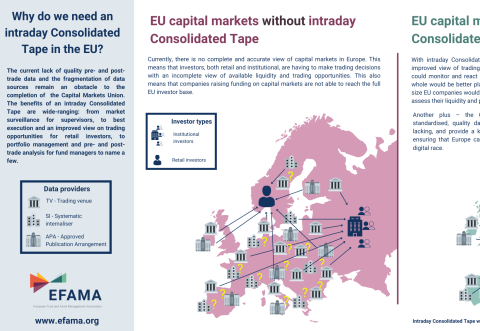
Visual | Why do we need a real-time Consolidated Tape in the EU?
The current lack of quality pre- and post-trade data and the fragmentation of data sources remain an obstacle to the completion of the Capital Markets Union. The benefits of a real-time Consolidated Tape are wide-ranging: from market surveillance for supervisors, to best execution and an improved view on trading opportunities for retail investors, to portfolio management and pre- and post-trade analysis for fund managers to name a few.
Investment Funds Distributor Due Diligence Questionnaire
Funds face unique challenges in performing intermediary oversight, and especially so because of MiFID II requirements, changing regulatory landscapes, and the absence of an industry agreed-upon standard between funds and their distribution channels. To help address these challenges, a dedicated working group developed a uniform due diligence questionnaire (DDQ) that will serve as the standard for investment funds (UCITS and AIFs) in performing onboarding and ongoing oversight of distribution channels.